Lesson 16: David defeats Goliath
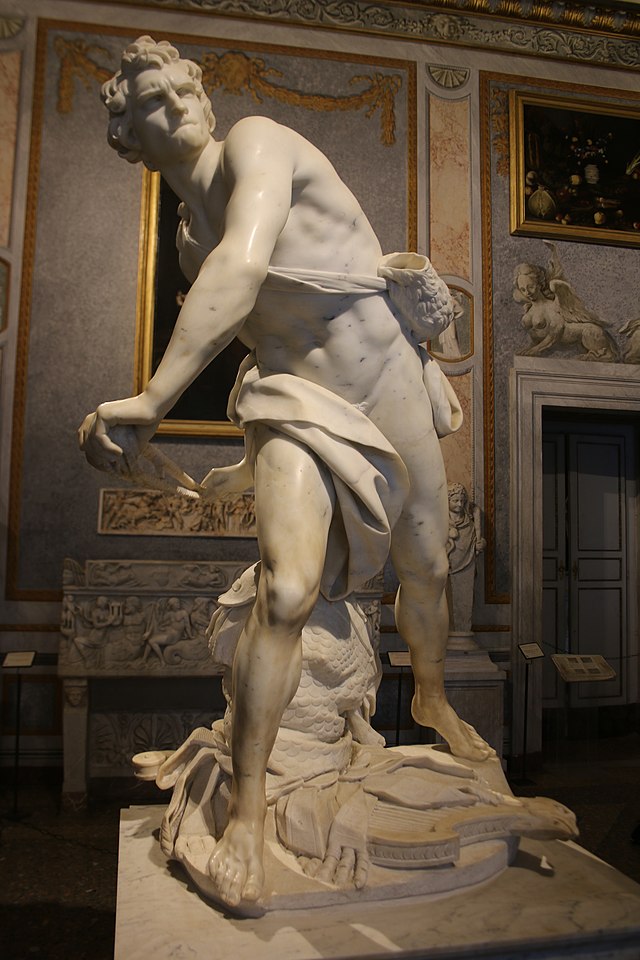
In looking for a painting or a representation of David and Goliath, I’ve been disappointed to find that many of the painters either show David holding Goliath’s severed head or getting ready to decapitate Goliath with Goliath’s own sword. I understand the choice of subject for the painters – it’s bold and exciting. What I think it captures is the righteous, boy warrior at the beginning of his recognized power as the true anointed king of Israel.
And yet, the picture I envisioned of David is more of him waiting for Goliath to finish his taunt, when the coming outcome of the battle was unknown to all the witnesses of the event. “’Am I a dog, that you come at me with sticks?’ And the Philistine cursed David by his gods. ‘Come here,’ he said, ‘and I’ll give your flesh to the birds and the wild animals!’ (I Samuel 17:43 – 44)
If we had been present to witness this event, we would be wondering what would happen next. Would the giant warrior of the Philistines hurl his javelin and pierce David through so that the spearhead comes out the back? Will the giant rush David and snatch him with one hand by the neck and break it? Would David hurl his stone and the Philistine just brush it aside like a gnat then crush him under his foot? Is David’s face full of fear?
With the benefit of hindsight, we know that none of these things occurred. Instead, future painters would paint the seminal event with the boy warrior, David holding Goliath’s head by his hair with Goliath’s dead face looking surprised.
Consider the differences between Goliath and David. Goliath was a proven warrior; else, he would not have been a champion to fight on behalf of the Philistines. He was huge – nine feet tall – and strong, as his weapons and armor were quite hefty. David was just a shepherd boy who refused Saul’s armor because he could not move in them. Goliath probably killed many in service to the Philistines where David had killed one lion and one bear protecting his father’s flock.
We are not surprised because David won the contest with Goliath – it’s part of our history. Even to this day, David and Goliath is used to describe the scrappy underdog who has a slim chance of victory in battle with the overwhelming, expected champion.
But, that was never the case, was it? Standing on the outside of the battle looking in, we could rightfully expect that David would be slaughtered by Goliath. But standing where David stood, he fully expected to win the battle because the LORD was on his side.
Let’s see this story from the beginning.
Saul had failed God. First, he was told to wait for Samuel to make a sacrifice before going into battle. When Samuel didn’t show up after seven days as expected, Saul began to see his men start to disappear from duty. So, Saul decides to offer the sacrifice. Samuel informs Saul that he will have no legacy after his reign – someone other than his family will rule. (1 Samuel 13)
Saul fails God again. Through Samuel, God gives instruction to Saul to go against the Amalekites and to “totally destroy all that belongs to them. Do not spare them; put to death men and women, children and infants, cattle and sheep, camels and donkeys.” (1 Samuel 15:3) When Samuel arrives, he finds the best of the Amalekite animals are still alive (as well as King Agag). King Saul blames the troops saying, “they spared the best of the sheep and cattle to sacrifice to the LORD your God.” (1 Samuel 15:15) Samuel tells Saul what Saul already knew, “obedience is better than sacrifice.” (1 Samuel 15:22)
Now Saul is told, “You have rejected the word of the Lord, and the Lord has rejected you as king over Israel!” (1 Samuel 15:27) As Samuel turns to leave, Saul, in his desperation, reaches out to grab hold of Samuel and tears his cloak instead. “The Lord has torn the kingdom of Israel from you today and has given it to one of your neighbors—to one better than you.” (1 Samuel 15:28) Saul pleads with Samuel to go up with him to sacrifice (so Saul does not lose face before his men). Samuel relents, but first has the Amalekite King Agag brought out and kills him as further witness of Saul’s failure before God. (I Samuel 15:32 – 33)
Later, David is brought in from the sheep fields as the youngest of Jesse’s sons and is anointed by Samuel at God’s direction because “People look at the outward appearance, but the LORD looks at the heart.” (1 Samuel 16:7)
Now we get to the crux of our story. The Philistines muster on one hill and the Israelites under Saul muster on another overlooking the Valley of Elah. David, who’s been splitting his time with his father’s sheep and the royal palace playing the lyre for a tormented Saul, has come to the place of battle at Jesse’s behest to check on his other sons and provide some food from home.
Goliath had been going into the Valley of Elah between the armies and taunting the Israelites day after day – no Israelite would meet his challenge. “If I slay your champion, we’ll be your slaves! If your champion slays me, we’ll be your slaves!” (1 Samuel 17:9) Goliath had been taunting the Israelites and cursing them in the name of his gods.
David, having heard the taunt for the first time says, “Who is this uncircumcised Philistine that he should defy the armies of the living God?” (1 Samuel 17:26) He was incensed by the temerity of the Giant to say such things against the LORD.
Word gets to Saul about David who has been talking in the camp and he has David brought before him. David gives his qualifications – he’d killed wild animals with his sling when they tried to take his father’s sheep. With the LORD’s help, he would win the day. Saul first dresses David in his own armor which David, in his wisdom, refuses because they were unfamiliar to him (and he couldn’t even move in it).
Instead he picks up five stones from a stream and approaches the giant who taunts David as described above.
Everyone waited to see what would happen next. They didn’t have to wait long. David replied to Goliath, “You come against me with sword and spear and javelin, but I come against you in the name of the Lord Almighty, the God of the armies of Israel, whom you have defied. This day the Lord will deliver you into my hands, and I’ll strike you down and cut off your head. This very day I will give the carcasses of the Philistine army to the birds and the wild animals, and the whole world will know that there is a God in Israel. All those gathered here will know that it is not by sword or spear that the Lord saves; for the battle is the Lord’s, and he will give all of you into our hands.” (1 Samuel 17:45 – 47)
And David slung his stone into the forehead of Goliath and Goliath died. Then, with Goliath’s own swoard, David cut off Goliath’s head.
Would that this would happen to the AntiChrist when he shows up to battle the people of God. Instead, we know that the AntiChrist will have power initially over the whole earth for a limited time. Under his leadership, many will turn away from God and many Christians will lose their lives. And yet, even though those Christians will assuredly be persecuted and die for the cause of Christ, everyone of them can be as brave as David facing Goliath. Because the AntiChrist doesn’t win in the end. Instead, a Son of David will defeat the AntiChrist at the appropriate time. As Jesus said, “Don’t fear the one who can kill the body. Fear the One who can destroy body and soul in the lake of fire.”
You see, David defeated Goliath, but not by David’s own power. Instead, God gave him the victory – just as assuredly as every true Christian, persecuted or killed by the AntiChrist will also obtain the victory through Jesus Christ, our Lord.
Perhaps those paintings of David holding Goliath’s head are appropriate for this lesson after all.
Soli Deo Gloria
Lesson 17: “You are the man!”
“Who are you?”
When you get asked that question, how do you answer? Do you give your name? Do you give your occupation? Do you give your familial roles? The answer you give depends on the context of the question.
Can your sin define who you are?
Let’s look at the life of David to see if we can answer that question.
In 2 Samuel, David has already been a man after God’s own heart – especially in seeking God’s will for the different choices he makes and trying to worship and honor the LORD. His enemy, Saul, has died. Judah and the other tribes of Israel have acknowledged him as king. He conquered Jerusalem and moved the capitol to it. He’s been given victory after victory by the LORD. He’s been promised by the LORD that someone from his line will always sit on the throne especially after David expressed a desire to build a temple for God.
And yet, David makes poor choices beginning in 2 Samuel 11.
- Poor choice 1: At the time of year when the kings were to go off to war, David sent out his army and stayed behind.
- Poor choice 2: As he could not sleep one night, he prowled about the top of his palace where he saw a woman at her bath.
- Poor choice 3: He sends to find out who she is.
- Poor choice 4: He sends for her to come to his palace and has sex with her.
She later sends a note to him to tell him that she is pregnant.
- Poor choice 5: He sends for her husband, Uriah the Hittite, to come from the army so that Uriah would sleep with the pregnant wife and all would think the baby belongs to Uriah.
- Poor choice 6: When Uriah refuses to go to his house over several days because the army also can’t come home, David sends Uriah back with a letter for Uriah to die in battle which David’s commander fulfills.
Then, David brings the widow into his house and marries her.
Do you see how David’s choices lead him further and further into sin? So, let’s see how these actions could define David.
- David was irresponsible for shirking his duty of leading the army into battle.
- He acted in lust first gazing at naked Bathsheba and then sending for her.
- He committed adultery (and rape? He was the king after all) when he slept with Bathsheba.
- He schemed to coverup his sin by sending for Bathsheba’s husband, Uriah.
- He murdered Uriah when the coverup scheme failed because of Uriah’s good character.
David – irresponsible, lustful, adulterer, schemer, and murderer. These are not the kind of identifying labels that we associate with David, the man of God.
So, what happened? God decided to confront David; however, God does so obliquely to demonstrate to David just how much he has fallen.
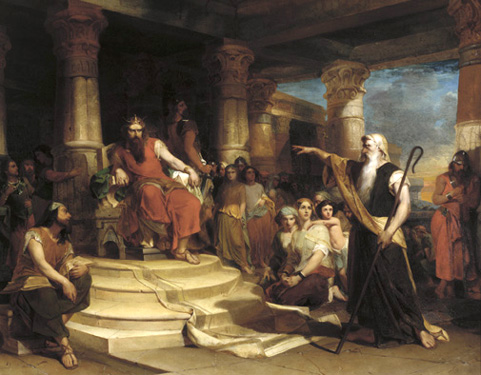
God sends Nathan, the prophet, to David with a story about a rich man who rudely steals the only, beloved lamb from a poor man’s family to slaughter for a meal for a visitor instead of taking an animal from his own herds.
David hears the story and burns with anger. “The man deserves to die!” he exclaims.
“You are the man!” says Nathan.
Then, God, through Nathan, lays out all the sin that David has committed. And how does David respond?
“I have sinned against the LORD.” This is the first good choice he’s made in this whole sordid mess. David repented. He didn’t just feel remorse (because he was found out). He truly repented of his sin and confessed it before the LORD.
And God immediately forgave him. (“If we confess our sins, he is faithful and just and will forgive us our sins and purify us from all unrighteousness.” 1 John 1:9)
Of course, God did not remove the consequences of his sin. The son of the illicit liaison with Bathsheba dies after three days. David’s other sons commit crimes for which David has lost the moral authority to punish or control. Both criminal sons die (Amnon and Absalom).
“Who are you?” When we look at David, we know he is unique in God’s eyes. (And so are you.) When we look at David (in this episode), we know that he is a sinner. (And so are you.) When we look at David when he confesses, we know that he is forgiven. (And so you can be, too.)
In the end, David is not defined by the sins he committed – and neither will you be either if you repent of your sins and seek God’s forgiveness through Jesus Christ.
“For as high as the heavens are above the earth,
so great is his love for those who fear him;
as far as the east is from the west,
so far has he removed our transgressions from us.” (Psalm 103:11 – 12)
The End Time which is coming will include crisis after crisis where God brings his wrath upon sinful humanity and the saints will suffer persecution. The purpose of this time is to confront the sinners with their sin so they have an opportunity to repent, give courage to the saints to stand firm in the faith, and widen the divide between those who choose forgiveness and those who choose to remain enemies of God. (There will be no fence-sitting, or agnosticism, at that time.)
Finally, it is always possible for a person of God to fall into sin. I’m sure you can think of others who have been found out like David. If you are a Christian believer, seek God always and turn away from sin so that your witness for him is undamaged.
A pastor I know heard a person say, “I am not going to church! It’s full of hypocrites!” To which he responded, “Yes, I know. We have room for one more.”
“Seek the LORD while he may be found; call on him while he is near.” (Isaiah 55:6)
Lesson 18: Uvalde, TX and Naboth

Marco Bello | Reuters as posted on cnbc.com
Recently, an 18-year-old gunman went into an elementary school in Uvalde, TX and slaughtered nineteen children and at least two teachers. The sense of shock and grief elicited by this act that we feel pales in comparison to the grief and loss that is felt by the families of these victims. The lyricist of Les Miserables said it best, “There’s a grief that can’t be spoken, there’s a pain goes on and on. . . “
May God grant His healing favor on the families of the victims.
Then anger burns against the gunman who was killed. Fantasies of the punishment he will suffer dance in our righteous heads. Questions of “what led him to such an act?” seek answers to prevent such individuals from repeating such horrendous crimes.
And finally, we land on the one question that many will ask, “Why did God allow such a thing to happen?” And we wonder what answer He would give.
Our emotions about these atrocities will fade – most of us did not personally suffer consequences because of the act of this one gunman. As shocked or grief stricken as we might personally be at this moment, it will soon enough become just another historical event except for the ones who have lost loved ones or personally interacted in this crisis in Uvalde.
Yet the question remains relevant, “Why did God allow such a thing to happen?”
In 1 Kings 21, we see another event that leads to this same question. King Ahab, who has been a wicked king of Israel, wanted to buy a vineyard from a man named Naboth. Ahab approaches Naboth and offers to give him another vineyard or money in exchange for Naboth’s vineyard so that Ahab can have a garden close to his palace.
Naboth refuses.
Naboth’s refusal is not mean-spirited but based on the provision that the LORD had given the land to his forefathers as part of the parceling of the land to the tribes of Israel in the time of Moses and Joshua. As such, Naboth’s intention is to leave the land to his descendants as God had directed.
Dejected, Ahab sulks for a long time that he wouldn’t get Naboth’s vineyard. Then, Ahab’s wicked wife, Jezebel, comes up with an evil plan to take care of the obstacle.
She sends letters under the king’s seal to elders of Jezreel for Naboth to be accused by two liars who will claim that Naboth cursed both the king and God. The elders comply with the plot.
A banquet is held and Naboth is given a seat of honor across from two scoundrels. The scoundrels accuse Naboth with lies. Naboth is seized and taken out of the city and stoned to death. Ahab takes possession of Naboth’s vineyard.
Afterwards, God sends Elijah, the prophet, to Ahab and relays the LORD’s anger and judgment. “In the place where dogs licked up Naboth’s blood, dogs will lick up your blood—yes, yours!” (1 Kings 21:19) Out of all the evil that Ahab had done as king, the act of killing Naboth and stealing his vineyard is when God decrees that Ahab is sentenced to death.
In reading this account, I had to ask, “Why didn’t God just protect Naboth in the first place?” I searched the Internet and found no one had attempted to ask this question about Naboth or provide an answer. The tragedy in Uvalde reminds us that this question is still relevant to this day. If you live long enough, some personal crisis or tragedy will inevitably lead to asking a similar question, “Why did God allow this (fill in the blank) to happen?”
It’s a question that deserves an answer and we all will do well to seek one. Non-believers will ask this same question of you because of your faith in God so you should “Always be prepared to give an answer to everyone who asks you to give the reason for the hope that you have. But do this with gentleness and respect.” (1 Peter 3:15)
I reject answers that discount God’s existence, goodness, or ability because I believe that God exists, loves all of us, and is able to do anything. So, here are the answers which are in-line with my belief to the generic problem of evil:
- God created mankind with the freedom to choose. As such, people can choose to do actions either good or evil. Because we live in a fallen world, sometimes the choice of evil actions have terrible consequences for others.
- Satan bears responsibility for evil actions (but he is not solely responsible). Satan tries to tempt mankind to turn away from God. These evil acts by tempted people are part of his purpose to achieve discord between mankind and God. (Even the angels have been given freedom to choose just as humanity has.)
- Sometimes bad things are allowed to happen because God is testing (and growing) his people.
- Bad things happen to sinners in this life as a judgment such as when Israel turned away from God and was defeated and exiled by Babylon. (I personally do not think that this answer applies to Naboth or Uvalde.)
- We don’t know the answer.
And that leads to frustration – especially when we just don’t know. We shake our fist at God and say, “Why God?” It’s the same question Job asks when he’s lost everything. His friends tell him, “Because you sinned.” (They were wrong.) When God finally speaks to Job, he doesn’t say, “Because I was testing you.” Instead, God shows Job that God is God and Job is not.
We may not know the answer because “My thoughts are not your thoughts, neither are your ways my ways,” says God in Isaiah 55:8.
In light of these events, we are left with a choice to make.
- We can choose to turn away from God. (This is what I did when my father died unexpectantly – he didn’t die from an evil act, but for me, his death was devastating. Thanks be to God, he sought me out and brought me back.)
- We can choose to trust God despite the evil, because we know that He loved us enough to let His own Son, Jesus, suffer evil for our sakes by letting him be arrested on false charges, scourged, beaten, bloodied and crucified. God placed on Jesus our sin (yours and mine) to redeem us to God.
We may not ever understand the reasons for all the crises in this life – but we can be assured that God loves us.
Finally, we understand that evil acts will continue in this fallen world. How do we know? In Revelation, the fifth seal which is opened by the lamb is a multitude of the souls of the saints who were killed because of their faith before the altar in heaven. This event occurs after the “Four Horsemen of the Apocalypse” are allowed to do their will upon the earth.
My prayer for you today is for God to bring you the healing and peace that you so desperately need. I also pray that you will turn to Jesus as Lord and Savior if you haven’t already. As for those who commit evil acts and don’t turn to Jesus, “their doom is sure.” Finally, I pray that you will be like Jesus and provide healing and peace to others who are suffering.
What is this site?
I created this site to discuss end time prophecy. Out of all the prophecies in the Bible, the end time prophecies are the ones that have yet to happen. Most of these were recorded in the book of Revelation; however, several other books in both the Old and New Testament speak about the end times.…
The Context of the Study
“Behold I stand at the door and knock. . . (Rev. 3:20) ” The Context or My Testimony When I was a boy of seven years, I went to my Mother and my Father and stated with certainty, “I want to be a Christian.” I had grown up in the church for as long as…
My Testimony
When I was seven, I became a Christian. The following Sunday, I was baptized. Life was perfect ever since. Wouldn’t that be nice? Of course, you know that life is not perfect and it hasn’t been for me either. I won’t bore you with everything that happened. I grew up in the church. I went…
Get new content delivered directly to your inbox.
 End Time Prophecy Study