Lesson 19: The Sin of David Revisited
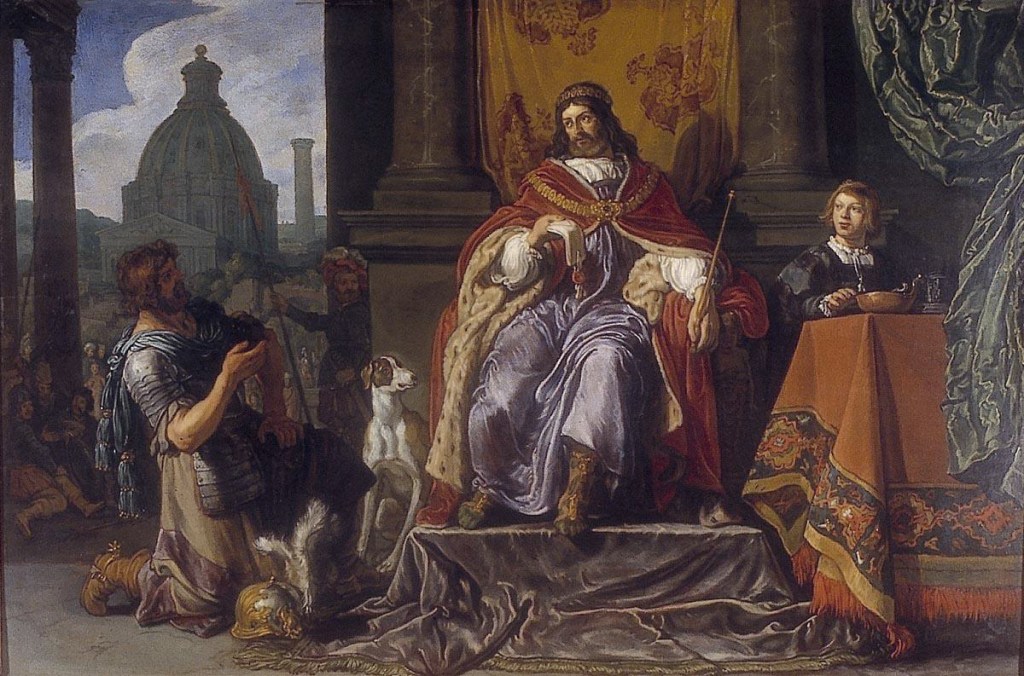
(David sends this letter by Uriah to Joab, the commander of the army, to “Put Uriah out in front where the fighting is fiercest. Then withdraw from him where he will be struck down and die.” 2 Samuel 11:15)
While researching for this lesson, I came across an article called “The day David became an atheist” on the website churchleaders.com. The author tempers his bold claim by explaining that David became a “momentary atheist” when he sends to Joab the message “Don’t let this upset you; the sword devours one as well as another.” (2 Samuel 11:25) These are the words David speaks upon hearing that Uriah (whom David had murdered) died in battle.
The author further goes on to say, “In other words, David is saying that God doesn’t exist. People die by the sword randomly and there is nothing that kings, generals (sic) or soldiers can do about it.” I think the author is overreaching in his interpretation of David’s statement. However, his next statement was much closer to the mark, “God is not sovereign.”
That’s when I stopped reading the article. Throughout David’s sinful tenure of lusting for and committing adultery (and rape?) with another man’s wife, scheming to hide the truth that he fathered her child, and ultimately murdering her husband, and then sending a flippant statement, David was really saying “God is not MY sovereign.”
Recently, the Southern Baptist Convention published a 288-page report highlighting a series of sexual abuse by pastors, ministers, and volunteers against victims. Part of the finding of the report is that members of the Executive Committee of the SBC who heard of the abuse at the time either quashed the stories or ignored the stories. (Much like the Catholic hierarchy when their scandal of sexual abuse by clergy was also brought to light.)
Unfortunately, we shouldn’t be surprised. In a lot of these instances, these people did exactly what David did, they ignored God as their sovereign to commit these sins. It makes you wonder how ordinary people can do such horrific things.
When I think of evil, I always imagine Adolf Hitler as the human version of evil. However, if Hitler had been left to himself, his impact of evil would have been quite small. The problem was that he was the leader of many in the commission of evil acts.
Dr. Christopher Browning wrote a book titled Ordinary Men: Reserve Police Battalion 101 and the Final Solution about 450 men from Hamburg who served in Poland as part of the German occupation in World War II. See the excerpt from Kirkus Reviews taken from amazon.com below (The bold italic type is my emphasis.):
“For 16 months, Reserve Police Battalion 101, a unit of just over 450 men from Hamburg, was responsible in Poland for the shooting of 39,000 Jews and the deportation to Treblinka of 44,000 more. The horror began on July 13, 1942, when the unit’s commander, one Major Trapp, ordered his men to round up 1,800 Jews from the village of Jozefow, to select several hundred as “work Jews,” and to shoot the rest–men, women, and children. Trapp apparently gave the order with tears in his eyes and gave permission to older soldiers not to participate. Altogether, 10 to 20 percent of the battalion availed themselves of this permission. The remaining men carried out the assignment: “the shooters were gruesomely besmirched with blood, brains, and bone splinters. It hung on their clothing.” What sort of men were they? Browning bases his answers on the judicial interrogation in the 1960’s of 210 men from the battalion. They were ordinary men, he finds, on the elderly side, drawn from the lower orders of German society, and few had an education above junior-high-school level. And after examining studies dealing with this phenomenon and evidence of such conduct in other wars, Browning determines that it’s not just Nazism or Germans that produces such men: There were American units in the Pacific that boasted of never taking captives. “If the men of Reserve Police Battalion 101 could become killers under such circumstances,” he writes, “what group of men cannot?” — Copyright ©1992, Kirkus Associates, LP. All rights reserved.”
In this instance, and in two psychological experiments, the Milgram Obedience Study, and the Zimbardo Prison Experiment, we see that ordinary people start to commit evil acts under the aegis of an authority. I suspect that much of the evil which will be perpetrated by people living through the end time will happen in just this manner as the world follows the coming Antichrist.
However, David didn’t submit to authority when he sinned against God. Hitler, Stalin, Mao (and you can think of others) didn’t submit to an authority either. “God is not my sovereign” explains all their murderous choices. In fact, whether one submits to a human authority or not, “God is not my sovereign” explains all evil acts perpetrated throughout time and everywhere.
Frankly, everyone has a god which is sovereign in their lives. You get to pick which one you will follow. Will it be wealth, fame, another person, an object, yourself, or some other lesser god? Or will it be God who created heaven and earth and who sent His son, Jesus, to redeem you? In the end, whichever you pick, we all will recognize that “God was always sovereign.” We will either live into that truth or not.
Lesson 20: Prophecy against Jeroboam’s Altar

I love art. One of my favorite pastimes is to visit a museum and see the great paintings by masters of the art. I’ve seen great art in the Vatican, the Uffizi, the Smithsonian, and the Metropolitan Museum of Art to name a few. When the King Tutankhamen exhibit came to the United States, my family traveled to one of the four cities to wait in line four hours to see the treasures from the burial tomb of King Tut.
I have never seen this painting in person by Jean-Honore’ Fragonard who painted this in 1752 when he was 20 years old. With this painting he won a grand prize. The subject was chosen by the committee who established this competition. Fragonard evidently had struggled with painting the split altar according to the article in Wikipedia.org.
King Jeroboam is not nearly as well known in our culture as King David or even King Saul. Because of King Solomon’s sin of sacrificing to the pagan gods of his wives and concubines, God had determined to tear the Kingdom of Israel in two – Jeroboam, who had been an official over the labor pool of the tribes descended from Joseph, would rule Israel and Rehoboam and, Solomon’s son would rule Judah.
Here’s how Jeroboam became king of the ten tribes of Israel. Ahijah, a prophet of the LORD, met Jeroboam outside of Jerusalem. Ahijah tore his own new cloak into twelve pieces and told Jeroboam, “Take ten pieces of this cloak because God Almighty is giving you ten tribes of Israel to rule as king of Israel. Solomon’s son will have one tribe and rule over it as king for the sake of his grandfather, David, so that David will have a lamp before me in Jerusalem where I have chosen to have my NAME.” (see 1 Kings 11:29 – 37)
“If you do whatever I (God speaking) command you and walk in obedience to me and do what is right in my eyes by obeying my decrees and commands, as David my servant did, I will be with you. I will build you a dynasty as enduring as the one I built for David and will give Israel to you. I will humble David’s descendants because of this, but not forever.” (1 Kings 11:38 – 39)
Now, Jeroboam became king over the ten tribes of Israel after Solomon died. However, Jeroboam believed he had a problem. As part of the law, God had decreed that every man should go up to Jerusalem three times a year to worship the LORD at the Temple located in “enemy” territory. Jeroboam was afraid that the people of whom he was king would go over and submit to the kingship of Rehoboam, King of Judah, when they worshipped in Jerusalem since Rehoboam was king in Jerusalem. Instead of following God and trusting in His decree, Jeroboam concocted a sinful plan by establishing two gold calves, one in Bethel and one in Dan, and declaring to the people of Israel, “It is too much for you to go up to Jerusalem. Here are your gods, Israel, who brought you up out of Egypt.” (1 Kings 12:28)
Throughout the rest of 1 and 2 Kings, the sin of the kings of Israel are compared to the terrible sin of Jeroboam, son of Nebat. the first king of the ten tribes of Israel, because Jeroboam did not follow the LORD and turned the people away from God with his idols.
In 1 Kings 13, we come to the event as depicted by the painting above. Jeroboam is sacrificing at the altar of the golden calf in Bethel when a prophet of the LORD comes to pronounce judgment against the altar. “Altar, altar! This is what the Lord says: ‘A son named Josiah will be born to the house of David. On you he will sacrifice the priests of the high places who make offerings here, and human bones will be burned on you.’” That same day the man of God gave a sign: “This is the sign the Lord has declared: The altar will be split apart and the ashes on it will be poured out.” (1 Kings 13:2 – 3)
Jeroboam stretches out his hand and orders his men to “Seize him!” but Jeroboam’s hand shrivels up so that he cannot draw it back. The altar splits apart and the ashes pour out just as the LORD had proclaimed through the prophet. Now, the apostate Jeroboam asks the prophet to “intercede for me with the LORD your God, so that my hand is restored.” And the prophet intercedes on his behalf and Jeroboam’s hand is healed. (1 Kings 13:4 – 6)
Jeroboam tells the prophet to come to his house and have a meal and a gift to which the prophet refuses as God has told him to not eat bread or drink anything until he returns to Judah. (1 Kings 13:7 – 10) (The prophet later gets tricked by another man to eat a meal and dies because he did not follow God’s word – but that’s a different lesson. See 1 Kings 13:11 – 34)
What can we learn from this event in relation to the end time?
- Mankind tends to turn away from God for their own purposes as Jeroboam did.
- Mankind will substitute God with false idols (other than the true God) and proclaim it a good thing as Jeroboam did when he created the gold calves at Bethel and Dan.
- Mankind will rebel against the word of the Lord, as Jeroboam did when he ordered that the true prophet of God be seized.
- Ultimately, mankind will have to agree that the LORD is God even if they still refuse to obey Him. Jeroboam recognized that the LORD is God in asking for his hand to be restored – but he did not repent of his sin and follow God after this event. In the End Time when the prophecy “at the name of Jesus every knee should bow. . .and every tongue acknowledge that Jesus Christ is Lord,” (Phillipians 2:10 – 11) is fulfilled, not every person who will acknowledge that Jesus is Lord is going to be happy about it.
- Every believer in the End Time will be called upon to follow God even when it is difficult.
- In the end, God is supreme. Every word of His prophecy will be fulfilled just as He planned.
In the history of the split kingdoms after Jeroboam and Rehoboam, some kings of Israel and Judah follow the LORD (and others do not), but it’s not until a boy named Josiah becomes king that all the high places, and false idol altars are ultimately destroyed, just as God had indicated through the prophet.
Pray for revival so that people will turn to God as He has already demonstrated His love for us.
Lesson 21 – Ahab and Elijah at Mount Carmel

Have you ever completed a task and decided to completely redo it? That’s what happened working on this lesson.
When I first prepared this lesson, I used the sympathetic viewpoint of Elijah like I always have when I think about this event. Elijah is the lone the prophet of God in the face of unbelief by a mass of people who represent the legal authority and the religious authority for the nation of Israel. At first, when he chides the people to make up their mind on which god to serve, the people are silent. Who wouldn’t be sympathetic to the one who is right and will be proven correct?
And, the result? God wins. Elijah wins.
However, then I ask this question – if I had been physically present when this event happened, what part would I have played? If I’m honest, I probably would have been one of the silent people. And then I consider King Ahab – what was he thinking about this event? You see, I remember the time when I turned my back on God, just like King Ahab did.
There are times even now when I go to some event like a concert, show, or sporting event and I look at the crowd and think – how many of these people know Jesus?
So, I reworked this lesson from King Ahab’s viewpoint.
In 1 Kings 18, Ahab is searching for water. He’s just been to see his court official, Obadiah, and sent him off to search for water in the other direction.
Three years earlier, the prophet of the LORD, Elijah, had come before Ahab and declared that the God of Israel, the LORD, had decreed a drought on the land for the next few years (because of the sin of worshipping other gods). (1 Kings 17:1)
Ahab (who was more evil than any king ever) became king of Israel when his father, King Omri (another evil king) died. Ahab had married a Philistine princess named Jezebel who sought to increase Baal worship in Israel. Her program included the murder of interfering prophets of the LORD (who were busy telling the people that Baal worship was evil).
Unknown to Ahab (and Jezebel), Ahab’s trusty court counselor, Obadiah, was hiding 100 prophets of the LORD in caves and feeding them to protect them from Jezebel’s wrath. As Obadiah is searching for water in the opposite direction of Ahab, Elijah appears to Obadiah. “Go tell your master, ‘Elijah is here.’” (1 Kings 18:8) Initially, Obadiah is afraid that if he goes to King Ahab with the message, that Elijah may disappear, and Obadiah will be killed. After Elijah reassures Obadiah, Ahab is approached.
“Is it you, troubler of Israel?” spits Ahab when Elijah is in his presence. (1 Kings 18:17) Remember, Ahab worships Baal and Asherah and not the LORD of Israel whom Elijah worships. Ahab therefore lays the blame for the drought on Elijah who prophesied it.
Elijah rightly assigns the blame for God’s wrath where it belongs. “I have not made trouble for Israel,” Elijah replied. “But you and your father’s family have. You have abandoned the LORD’s commands and have followed the Baals. Now summon the people from all over Israel to meet me on Mount Carmel. And bring the four hundred and fifty prophets of Baal and the four hundred prophets of Asherah, who eat at Jezebel’s table.” (1 Kings 18:18 – 19)
What could Ahab say? Of course, he agreed. God had already demonstrated his power by the judgment of the drought.
So, King Ahab summons the people of Israel and all the prophets of Baal and Asherah to come to Mount Carmel. Elijah then proposes a contest to see who is powerful who is not. Each side would prepare a sacrifice. The prophets of Baal would prepare a sacrifice for Baal and Elijah would prepare a sacrifice for the LORD. However, no one was to light the sacrifice except the god that was being honored. Baal would have to light the sacrifice prepared for him and the LORD would be called on to to light the sacrifice prepared for Him. Elijah tells the prophets of Baal to go first.
Starting that morning, the prophets of Baal build an altar to Baal, put wood on the altar and sacrifice a bull. Then they stand back and pray to their god.
Nothing happens.
They call out loud to Baal and become more animated. They begin to cut themselves and bleed out. (Remember that the Hebrews understood from the law that life was in the blood. In a real sense, the Baal prophets were offering their lives by spilling their blood to Baal if only he would respond.)
About noon, Elijah begins to taunt them. “Maybe he’s sleeping! Maybe you should yell louder!” The Baal prophets were beside themselves to get a response – any response – from their false god.
Nothing happens.
As the time for the evening sacrifice approaches, Elijah takes his turn. Ahab watches him after the failure of the Baal prophets and their false god. Elijah takes twelve stones, symbolic of the twelve tribes of Israel, and builds an altar. He puts wood on the altar. He sacrifices a bull. And he digs a trench.
I’m sure Ahab is thinking – “why a trench?” The purpose of the trench becomes obvious when Elijah enlists the help of people to get four big jars of water and pour it over the altar. Then he sends them again – “get more water and pour it over the altar and the sacrifice.” Then, Elijah sends them a third time – “fill up the four jars with water and pour it over the altar.” There is so much water poured over the altar that it fills up the trench! It all stayed gathered in one place instead of flowing away.
Now, if you’ve ever started a fire, you know you don’t put water on the thing you want to burn – it just won’t light.
Ahab watches as Elijah prays. Perhaps he heard the words just as the people did. “Lord, the God of Abraham, Isaac, and Israel, let it be known today that you are God in Israel and that I am your servant and have done all these things at your command. Answer me, LORD, answer me, so these people will know that you, LORD, are God, and that you are turning their hearts back again.” (1 Kings 18:36-37)
And God answers the prayer immediately. Fire rains down from heaven to the altar that not only consumes the sacrifice, the wood, the stones, and the soil, but it completely obliterates the water from the trench!
What could Ahab do but believe the evidence of his own eyes as the people exclaim, “The LORD! He is God! The LORD! He is God!” (1 Kings 18:39)
Ahab could only watch as Elijah seizes the moment and calls on the people to grab the 450 prophets of Baal (and the other false prophets) and have these emissaries of the false gods put to death. Afterward, King Ahab could only look at Elijah in astonishment when Elijah approaches him and says, “Go eat and drink. I hear the sound of a heavy rain.” (1 Kings 18:41)
Ahab returns to his tent. I imagine that he was in shock by what he saw. The God of the Israelites, whom Ahab had rejected had brought fire from heaven at the prayer of this ONE MAN where Baal, the non-existent god he (and his wife) revered had done NOTHING.
While Ahab ate dinner, wondering at these events, Elijah’s servant comes to his tent and told Ahab that he better hitch up his chariot and leave before a terrible storm prevents Ahab from reaching Jezreel.
What else could he do? The prophet who had decreed a drought of the LORD, who had prayed and been answered by the LORD with fire from heaven, who had killed 450 (and more) ineffective prophets of Baal (some of which he probably knew personally) had just sent word that the LORD was going to send heavy rain. Ahab did the only rational thing – he hitched up his chariot and left.
He must have been very amazed when Elijah showed up ahead of him with no chariot to bring him to Jezreel.
Afterwards, Ahab told Jezebel everything that had happened. However, what he said to her did not include, “Perhaps we should rethink what we believe because this God of Israel, the LORD, may be the one true God and our worship of Baal is really pointless.” Instead, Ahab only acknowledged God’s power, but he never really turned to God as the one true God. (Even later, Ahab expresses remorse and humbles himself before God because of the judgment of God for his crime against Naboth, but he never truly turns to God which is why the prophecy against Ahab is delayed but ultimately fulfilled.)
So, what can we learn from this experience – especially from Ahab’s point of view in relation to End Time lessons?
- The LORD is God regardless of what anyone is going to believe.
- The LORD (Jesus Christ) is all powerful and will show up at just the right time.
- Following any god other than the LORD is going to be pointless, fruitless, and disappointing.
- Regardless of what the LORD does in demonstrating His existence, not all who will acknowledge His power will turn to Him as God.
- Some evil leadership in the form of Ahab (Antichrist) and Jezebel (especially the Revelation version) will show up at the End Time and set themselves against God.
- Doom will finally come to those who spurn the LORD (especially Jesus).
Both Ahab and Jezebel end up just as the prophecy against them was related to them after the episode of Naboth. Whereas Elijah is recognized as the hero that he is – taken to heaven in a fiery chariot.
But remember the real lesson from the contest on Mount Carmel which was evident to the people who exclaimed, “The LORD! He is God! The LORD! He is God!”
What is this site?
I created this site to discuss end time prophecy. Out of all the prophecies in the Bible, the end time prophecies are the ones that have yet to happen. Most of these were recorded in the book of Revelation; however, several other books in both the Old and New Testament speak about the end times.…
The Context of the Study
“Behold I stand at the door and knock. . . (Rev. 3:20) ” The Context or My Testimony When I was a boy of seven years, I went to my Mother and my Father and stated with certainty, “I want to be a Christian.” I had grown up in the church for as long as…
My Testimony
When I was seven, I became a Christian. The following Sunday, I was baptized. Life was perfect ever since. Wouldn’t that be nice? Of course, you know that life is not perfect and it hasn’t been for me either. I won’t bore you with everything that happened. I grew up in the church. I went…
Get new content delivered directly to your inbox.
 End Time Prophecy Study