Lesson 25: The Purpose of the Tabernacle
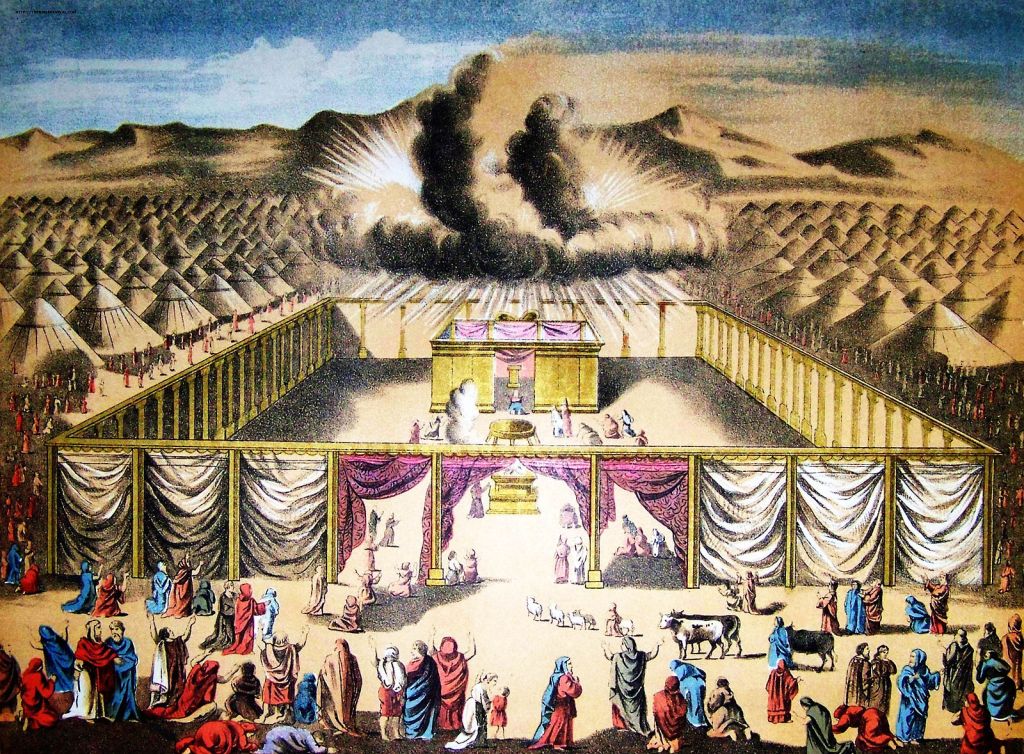
When Moses receives the Law from God on Mount Sinai, God also gives Moses the plans for the Tabernacle. Two underlying themes highlight the purposes of the Tabernacle. 1) God is holy, and the people are not. 2) God seeks a relationship with His people.
- God is holy and the people are not. Consider the righteousness of God. His Being is the very definition of “good.” He is the “measuring stick” of goodness that everything in creation gets measured against. We have a concept which is repeated over and over in the Bible about “sin.” But what is “sin?” It is anything and everything that we do that separates us from God – that makes us “not holy.”
Adam and Eve were created as “sinless” beings. But, tempted by Satan, they chose to “sin” against God by eating the fruit of the Tree of Knowledge of Good and Evil which He had commanded that they not eat. When they “sinned,” they effectively separated themselves from God. Everyone since then has “sinned” against God as it has now become our proclivity to sin – as Paul says, “For all have sinned and fallen short of the glory of God.” (Romans 3:23) Some people say that they have never sinned. But that concept is a deception. “If we say we have no sin, we deceive ourselves.” (1 John 1:8)
- God seeks a relationship with His people. Consider the majesty of God. He is all-powerful. He created everything that exists including time. As such, He can exist outside of reality and outside of time. No one else can do that. Also, He is everywhere. The Psalmist says, “If I go up to the heavens, you are there. If I make my bed in the depths, you are there.” (Psalm 139:8)
I’ve seen movies lately that depict Greek gods as requiring the devotion and worship of their believers to be a source for their powers. The less these people worship those gods, the less power they have. That concept does not apply to God. He is all powerful regardless of what any of us believe. He doesn’t need us at all. But He “wants” us; He “loves” us which is why He wants a relationship with us.
So, God gives Moses the plans for the tabernacle which is to sit in the middle of their camp surrounded by three tribes of Israel to the East, three tribes to the North, three tribes to the West, and three tribes to the South. Between the tribes and the tabernacle will be Levites on the North, West, and South sides and Aaron, Moses, and Aaron’s sons to the East where the entrance to the Tabernacle will be placed.
These are the elements of the tabernacle.
- It will have a court surrounded by curtains.
- In the tabernacle court will be the Altar of Sacrifice and the Laver for washing.
- Within the Holy place of the tabernacle will be the Table for the Bread of the Presence, the Lampstand, and the Altar of Incense.
- Between the Holy place and the Most Holy place (effectively, the Holy, Holy place) will be a curtain.
- In the Most Holy place will be the Ark of the Covenant where God (the Holy, Holy, Holy being) will dwell.
Now, let’s consider each of these elements separately.
The Altar of Sacrifice is the place where sacrifices will be made before God. These will be animal sacrifices where blood is spilled (remember, the Jewish concept is that the “life is in the blood”), and the animals consumed by fire. These sacrifices are made to expiate the sin of the people – to make them righteous. This is what is known as the “sacrificial system.” It fulfilled what God demanded. The problem was that people continue to sin after sacrifice so another animal sacrifice was needed to expiate those sins.
The Laver stood between the Altar of Sacrifice and the Tabernacle entrance. It was the place where the priests washed their hands and feet before they entered the tabernacle and before they offered sacrifices on the Altar of Sacrifice. The significance of the washing was to impress upon the people the need for purity.
Within the entrance of the tabernacle stood three major objects. The first was the Table of the Bread of the Presence. 12 loaves of fresh bread were placed on the table every seven days. The number 12 signified the 12 tribes of Israel standing before God. Bread was a symbol of God’s ongoing provision for His people as He gave them manna in the wilderness and protected them from their foes beginning with the Egyptians.
The lampstand was made with seven lamps coming from a single trunk in the shape of almond blossoms. The lamp was to be perpetually lit. This harkens back to the time of creation when God first uttered, “Let there be light.” In a real sense, God is the light for His people. The almond blossoms also harken back to Eden where sinless man and God interacted.
The Altar of Incense burned a spice mixture with the coals from the Altar of Sacrifice to rise before God. Part of the symbolism of this element is the prayers which go up to God. This also was a holy activity – mixing the spices with the result of sacrifice for the expiation of sin so that God would look with favor on his people. Two sons of Aaron, Nadab and Abihu, brought “strange fire” to the Altar of Incense, meaning they didn’t get the coals from the Altar of Sacrifice and God destroyed them.
The curtain between the Holy Place and the Most Holy Place (the Holy, Holy place where the Holy, Holy, Holy one dwelt), effectively gave a separation between man and God. Once a year, The High Priest would be able to go into the Most Holy place to fulfill His required sacred duties before the presence of God.
Within the Most Holy place was to be the Ark of the Covenant which held the Ten Commandments written by the finger of God on the stone tablets. As I recall, other items were put in the ark – a sample of manna in a jar and Aaron’s budded almond staff – but only the Ten Commandments are mentioned when David much later brings the Ark of the Covenant into Jerusalem. The Ark was made of Acacia wood with all gold inside and outside of the Ark. It also had four rings on the corners in which two long poles of Acacia wood were to be inserted and left there for moving the Ark. No one was to touch the Ark.
The top of the Ark had two cherubim (angels) with wings covering the ark and the angels looking at the cover. God said he would dwell above the Ark and there interact with Moses. We call this the “mercy seat” as this was effectively the throne of God on the earth.
When the tabernacle was built and dedicated along with Aaron and his sons as priest, the glory of the LORD filled the tabernacle such that none could enter it. (See Exodus 40)
In effect, God had setup a ritualistic sacrificial system to make his people holy before Him so that they could have a relationship with God. This was the purpose of the tabernacle. It was at the center of the encampment so that God would be the center of the lives of the Israelites. The glory of the LORD was atop the tabernacle in a cloud by day and a fire by night. When it moved, the people packed up and followed the LORD. When the glory stopped, the people unpacked and stayed.
The tabernacle was later replaced by the first temple, planned by David, and built by Solomon. Nebuchadnezzar, the Babylonian King, destroyed the first temple. After the exile, the High Priest, Ezra and the people built a second temple that was completely renovated by King Herod the Great. Herod’s temple is the one that Jesus visited. This temple was destroyed by the Romans in A.D. 70.
What does any of this have to do with the end times? There is an idea within scripture that suggests that another temple will be built during the end times. (See Matthew 24:15) In fact, there is already an institution (The Temple Institute) within Jerusalem that has made elements for a new temple.
The problem is how will a new temple be used? If it reinstitutes the sacrificial system originally established by God to Moses, then it will contradict the final sacrifice by Jesus on the cross. With Jesus death, the old sacrificial system of the Old Covenant ended and replaced with Jesus sacrifice and resurrection under the New Covenant. Also, Matthew records that the curtain which separated the Holy Place from the Most Holy Place in the temple was torn from top to bottom (by God to Man) when Jesus died which meant that through Jesus death, we could now approach God.
There’s a reason we haven’t seen a temple of God since AD 70. When Jesus was talking about “Tear down this temple and I will rebuild it in three days.” he wasn’t talking about the Temple, he was talking about Himself. The tabernacle/temple was the “old way” of how God dwelt with His people. Now that Jesus has ascended into Heaven, it is now God’s Spirit (the Holy Spirit) that now dwells with His people.
Paul records in 1 Corinthians 6:19, “Do you not know that your bodies are temples of the Holy Spirit, who is in you, whom you have received from God?”
Should a new temple be built before Jesus comes again, it will be used incorrectly by people worshiping God wrongly and then by the AntiChrist to proclaim his own godhood to all the people. There’s so much more to say on this subject as we look at the First Temple in the next lesson.
Lesson 26: The Ark of the Covenant – Part I
Before we discuss the first Temple, we need to spend a little time learning about the Ark of the Covenant.
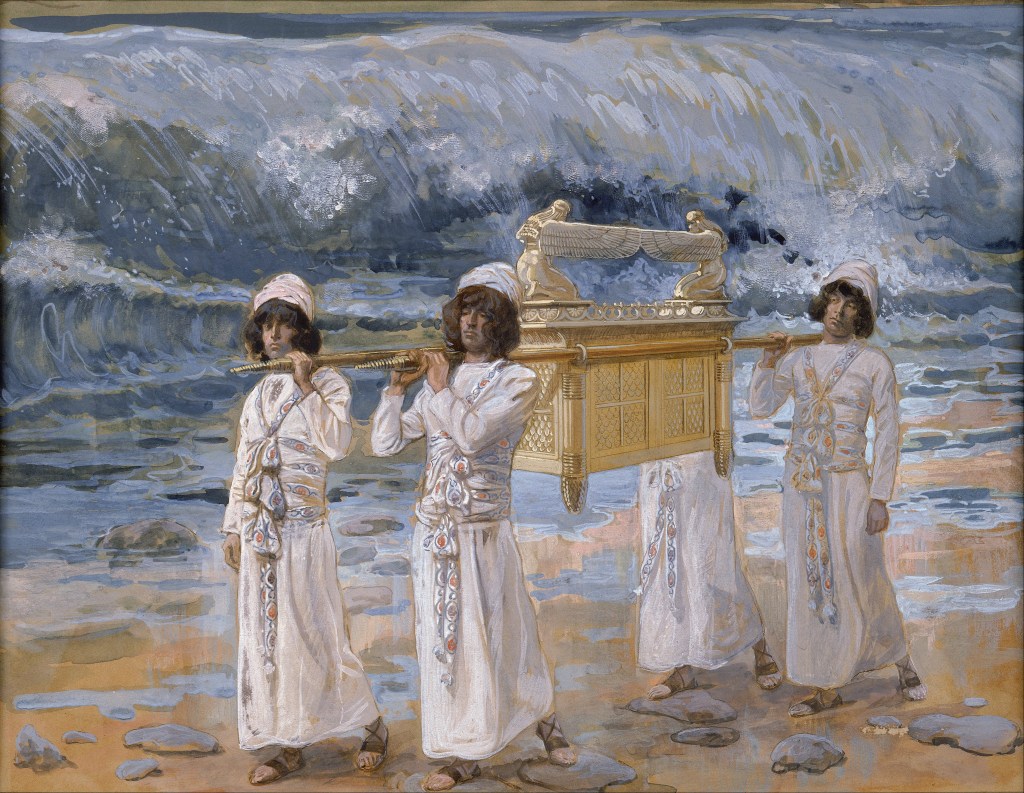
And the Lord said to Joshua, “Today I will begin to exalt you in the eyes of all Israel, so they may know that I am with you as I was with Moses. Tell the priests who carry the ark of the covenant: ‘When you reach the edge of the Jordan’s waters, go and stand in the river.’” (Joshua 3:7 – 8)
God had first given the design of the Ark to Moses along with all the other tabernacle furnishings and the design of the tabernacle. The nation of Israel encamped around the tabernacle which was placed at the center of the camp just as the LORD God was to be at the center of their lives. The purpose of the Ark was to hold the two tablets of the Ten Commandments which God had given to Moses and the cover of the Ark was to serve as the “mercy seat” where God would meet with his people. (Exodus 25:10 – 22)
As the priests carried the Ark into the waters of the Jordan river, it stopped flowing so that the entire nation of Israel could cross the Jordan into the promised land on dry ground. Twelve men, one from each tribe, each gathered a large stone from the middle of the now dry Jordan so that a memorial to God could be setup to help them remember all that God had done for them. (Joshua 3:14 – 4:7)
In the present day, we often wonder what ever happened to that Ark. According to a recent search on the Internet, the Encyclopedia Britannica talks about an Ethiopian legend that the Ark could presently be guarded by a virgin monk who cannot leave the grounds of the Church of Our Lady Mary of Zion located in Aksum. No one is sure whether the Babylonians took the Ark in the 6th Century B.C. or if the Egyptians had taken it (as popularized in the movie “Raiders of the Lost Ark.”)
The Book of Revelation talks about the Ark being in the heavenly temple. But as to its present whereabouts, no one is certain.
The truth is that the Ark was lost one other time; however, God providentially brought the Ark back to Israel. It happened this way.
When Samuel was a boy, the high priest at the time was Eli who had two sons. These priests of God disdained the offering of sacrifice to God because they did not follow the precepts on how they were to obtain their priestly portions. Eli rebuked his sons, Hophni and Phineas, but the sons continued to blaspheme against God.
A prophet comes to Eli and delivers God’s message – Eli’s house will be destroyed because he has not stopped his sons’ evil behavior and both his sons would die on the same day. This is also the message later given to the boy, Samuel, when God calls Samuel for the first time.
The prophecy gets fulfilled when the Israelites lose a battle to the Philistines and hatch a plan to have the Ark brought to the battle lines to ensure victory. However, the Israelites never consulted God as to their human plan. Hophni and Phineas bring the Ark to the front and a great cry goes up in the Israelite camp. The Philistines hear the cry and learn that “a god has come into the Israelite camp” and fight even harder the second day.
God allows the Philistines to defeat the Israelites on the second day of battle and thus fulfills the prophecy to Eli. A Benjamite who escaped the slaughter runs back with torn clothes and dirt on his body (a sign of grief) and delivers the news to Eli who is waiting by the road. The Benjamite delivers the hard news: the battle was lost to the Philistines, the sons of Eli had both died on the same day, and the Ark of the Covenant was captured.
When Eli hears about the Ark, he falls off his chair, breaks his neck and dies. The wife of Phineas hears the news about the death of her husband, her father-in-law, and the loss of the Ark and goes into labor. She gives birth and lays dying. The boy she calls “Ichabod” which means “no glory” because, “The Glory has departed Israel because the Ark of God has been captured.” (1 Samuel 4:12 – 22) But God was not finished with Israel.
The Philistines place the ark in the temple of the Philistine idol, Dagon. The next day, the Philistines find the idol on its face before the Ark of the LORD. They take the idol and set it back in its place. The next day, the idol is once again on its face before the Ark of the LORD and the head and hands of the idol have been broken off and placed on the threshold of the temple.
Along with this, God sends a plague among the Philistines such that the Ark gets moved from city to city as a pariah, but the plague moves with the Ark. Finally, the Philistines know that the God of the Israelites are punishing the Philistines because they are in possession of the Ark. Two cows which recently calved are hitched to a cart. The Ark is placed on the cart along with an offering of five gold tumors and five gold rats as a guilt offering to the God of Israel for the five cities and rulers of Philistine.
Normally, the cows would return to their penned calves. Instead, God had the cows move directly out of Philistine territory as witnessed by the Philistine and their rulers and stop in Beth Shemesh in Israel. The Levites there took the Ark and the chest of gold offering and broke up the cart and sacrificed the cows to the LORD. But, when some people looked into the Ark, God killed seventy of the people of Beth Shemesh. The Ark came to rest at Keariath Jearim. There it stayed for 20 years.
In one sense, God allowed Israel to fail in their battle with Philistine and the “mercy seat” to be captured to fulfill the prophecy against Eli’s house. Also, The Israelites failed to seek God’s will about their plan to bring the Ark into the camp of Israel to ensure their victory over Philistine in battle. God was not willing to let the Philistines keep the Ark and providentially caused the Ark to return. Finally, when the Ark does return to Israel, the Levites at Beth Shemesh should have been well versed on how to care for the Ark – that no one was to directly touch the Ark, let alone look inside it – so that the wrath of God would lash out.
We’ll learn more about the Ark in Part II.
Lesson 27 – The Ark of the Covenant – Part II

When David became King, he determined to bring the Ark from Kiriath Jearim to Jerusalem as one of his first acts. He gathered all the able-bodied men of Israel (about 30,000) to go with him to Kiriath Jearim to bring the ark of the covenant to Jerusalem. (2 Samuel 6)
God is described as “called by the Name, the name of the LORD” in 2 Samuel 6:2. Neither the Septuagint (an early Greek translation of the Old Testament by “the Seventy” translators) nor the Vulgate (an early Latin translation attributed to St. Jerome in the 4th Century A.D.) have “the Name” in their texts. However, the New International Version (which is the translation that I’m using) comes from an older text which translates YHWH (or Yahweh, meaning I AM WHO I AM” (Exodus 3:14) into the uppercase “LORD.” To the Israelites, God was so holy that they didn’t use this name often, so they would refer to the LORD as the “Name.” The Hebrew word is “HaShem” which literally means, “the Name.”
As God is so holy (and the Israelites considered even his name (YHWH) to be holy), the method chosen by David and his compatriots to move the Ark of the Covenant is confusing especially since the Ark of the Covenant was described as including the “mercy seat” where God was “enthroned between the cherubim of the Ark.” (also 2 Samuel 6:2)
The Ark was put on a new cart for transport to Jerusalem. The Ark had been at the home of Abinidab in Kiriath Jearim for many years. When the Ark was being carried on the new cart, the two sons of Abinadab, Uzzah and Ahio, were walking close to the Ark. When the Ark came to a particular spot, the oxen stumbled and Uzzah reached out to steady the Ark.
The anger of God lashed out and Uzzah died.
Wait, what? A member of the family that had watched over the Ark for twenty years died because he touched the Ark? Yes.
As described in the previous lesson, the Ark was returned by God’s interaction from Philistine to Israel on a cart drawn by cows that had recently calved. They had not gone back to their penned-up calves according to natural instinct, but carried the Ark directly into Israel because of God’s supernatural work. When the Ark arrived in Israel, some Israelites looked into the Ark and later died despite the Levites being present (and surely knowing how to treat the Ark according to the Law of Moses).
So, why did the Israelites, particularly David, use the Philistine method for moving the Ark to Jerusalem? Probably because the method had worked before so why not again? Uzzah paid with his life when he touched the Ark.
As the Israelites already knew, God is HOLY. Mankind is only allowed to approach God at God’s invitation. Did you know that the Ark of the Covenant when placed in the Temple was only approached by the High Priest of God and only once a year, on the Day of Atonement (Yom Kippur) and only after the High Priest had ritually had his own sin expiated before he could approach the Ark of the Covenant where God was “enthroned between the cherubim of the Ark?”
We read this part about Uzzah and we think like David, “God is too tough!” So, the Ark was taken aside to Obed Edom where it resided for three months after Uzzah died. David was angry at God and wondered, “How can the Ark of God ever come to me?” and wasn’t willing for the Ark to be in Jerusalem with him. (2 Samuel 6:8 – 10)
This is a typical reaction to God when we don’t understand why we endure pain when all we want is to please God and have him dwell with us.
The problem is that we cannot live without God. In fact, it’s better to die for God even if He chooses to let us die than to live without Him. For example, Hannaniah, Mishael, and Azariah refuse to bow down to a statue and worship it as described in Daniel 3. We don’t know them by their Hebrew names which honor God but by their Babylonian names – Shadrach, Meshach, and Abednego.
We all know the story, they refuse and are thrown into the fiery furnace and are saved by God. But, do you remember this part? Nebuchadnezzar gives them one last chance. “Do it or else! Then what God can save you?” And their response, “We don’t need to defend ourselves before you in this matter. If we are thrown into the blazing furnace, the God we serve is able to deliver us from it, and he will deliver us from Your Majesty’s hand. But even if he does not, (my emphasis) we want you to know, Your Majesty, that we will not serve your gods or worship the image of gold you have setup.” (Daniel 3:16 – 18)
Wow. The God we serve is Holy and worthy of such faith even in the possibility that He won’t save us from our time of trial. There’s a reason why Christians who die by persecution are called “Martyr” which literally means “witness.” (from Justin Martyr who was arrested in Rome for not worshipping Roman gods – see website from Christianity Today)
We can’t leave this story here. What happens to the Ark and David? The house of Obed Edom is reported to have many blessings. This report makes it to David’s ears. (2 Samuel 6:12)
This time, David has had the appropriate research done – how is the Ark supposed to be transported? The answer is that it is to be carried by Levites! That’s why it was constructed the way it was, with rings crafted at the legs of the Ark and the poles to be left in the rings so that the Ark could be carried. (see Exodus 25:14 – 15)
So, David tries one more time to bring the Ark of the Covenant to Jerusalem. This time, there is such joy. Those carrying the Ark would move forward six steps and then a bull and a fattened calf would be sacrificed. David, wearing a linen ephod, danced before the Ark with all his might. The Ark was brought up to Jerusalem with shouts and the sound of trumpets. (2 Samuel 6:13 – 15)
David had finally figured out how to honor the LORD God and bring the symbol of His presence into Jerusalem. However, he suffered a little persecution from his first wife, Michal who was a daughter of King Saul. Her response to his activity? “How the king of Israel has distinguished himself today, going around half-naked in full view of the slave girls of his servants as any vulgar fellow would!” (2 Samuel 6:20)
However, David had a ready response to the words of his wife, ““It was before the Lord, who chose me rather than your father or anyone from his house when he appointed me ruler over the Lord’s people Israel—I will celebrate before the Lord. I will become even more undignified than this, and I will be humiliated in my own eyes. But by these slave girls you spoke of, I will be held in honor.” (2 Samuel 6:21 – 22)
Next, we’ll learn about David and the first temple.
What is this site?
I created this site to discuss end time prophecy. Out of all the prophecies in the Bible, the end time prophecies are the ones that have yet to happen. Most of these were recorded in the book of Revelation; however, several other books in both the Old and New Testament speak about the end times.…
The Context of the Study
“Behold I stand at the door and knock. . . (Rev. 3:20) ” The Context or My Testimony When I was a boy of seven years, I went to my Mother and my Father and stated with certainty, “I want to be a Christian.” I had grown up in the church for as long as…
My Testimony
When I was seven, I became a Christian. The following Sunday, I was baptized. Life was perfect ever since. Wouldn’t that be nice? Of course, you know that life is not perfect and it hasn’t been for me either. I won’t bore you with everything that happened. I grew up in the church. I went…
Get new content delivered directly to your inbox.
 End Time Prophecy Study