Lesson 28: David wants to build a Temple for God

After David was given rest from all his enemies, he wanted to build a a temple to replace the tabernacle for the LORD. Nathan, the prophet of God, told King David “Whatever you have in mind, go ahead and do it, for the Lord is with you.” (2 Samuel 7:3)
The problem is that Nathan (nor David) had consulted God. (How often I have assumed that I should do something without first consulting God!)
Before we find out what God wanted, we need to consider the historical implications of the Tabernacle design that God had given to Moses in the desert. The Tabernacle was essentially a large tent with a courtyard that held all the other pieces God designed that could be carried by the Levites through the desert to the promised land. The tabernacle eventually ended up in Shiloh along with the Ark of the Covenant, the Altar of Sacrifice, the Altar of Incense, the Table of the Bread of the Presence, and the Lampstand.
During the time of the High Priest, Eli, God allowed the Ark of the Covenant to be captured by the Philistines. God providentially brought the Ark back to Israel where it stayed about 20 years in Kiriath Jearim. After David became king, he brought the Ark to his stronghold, Jerusalem, where the Ark stayed in a “tent.” (2 Samuel 7:2)
After Nathan had given his “human” answer to David, God came to Nathan that very night and told Nathan to take back a different answer from God regarding the desire of David to build a temple. (2 Samuel 7:4)
“Go and tell my servant David, ‘This is what the Lord says: Are you the one to build me a house to dwell in? I have not dwelt in a house from the day I brought the Israelites up out of Egypt to this day. I have been moving from place to place with a tent as my dwelling. Wherever I have moved with all the Israelites, did I ever say to any of their rulers whom I commanded to shepherd my people Israel, “Why have you not built me a house of cedar?”’ (2 Samuel 7:5 – 7)
Taken out of context, this sounds like a rebuke of David; however, we shouldn’t read it that way within the context of the rest of God’s answer.
“Now then, tell my servant David, ‘This is what the Lord Almighty says: I took you from the pasture, from tending the flock, and appointed you ruler over my people Israel. I have been with you wherever you have gone, and I have cut off all your enemies from before you. Now I will make your name great, like the names of the greatest men on earth. And I will provide a place for my people Israel and will plant them so that they can have a home of their own and no longer be disturbed. Wicked people will not oppress them anymore, as they did at the beginning and have done ever since the time I appointed leaders over my people Israel. I will also give you rest from all your enemies.
“‘The Lord declares to you that the Lord himself will establish a house for you: When your days are over and you rest with your ancestors, I will raise up your offspring to succeed you, your own flesh and blood, and I will establish his kingdom. He is the one who will build a house for my Name, and I will establish the throne of his kingdom forever. I will be his father, and he will be my son. When he does wrong, I will punish him with a rod wielded by men, with floggings inflicted by human hands. But my love will never be taken away from him, as I took it away from Saul, whom I removed from before you. Your house and your kingdom will endure forever before me; your throne will be established forever.’” (2 Samuel 7:8 – 16)
Although David’s thought processes are not quite what God wanted, he graciously tells David that instead of David building a temple, God will build a house for David. God says, “You will not build a house for me. But, I will build a house for you.” Starting with his son, which we later find out is Solomon, his line and kingdom will last forever.
We, who are living on this side of history, know that Jesus Christ is the ultimate heir of David and is the King of the Forever Kingdom of David. In 2 Samuel 7:16, God says to David, “your house and your kingdom will endure forever before me; your throne will be established forever.”
However, we must wonder at the statement, “When he does wrong, I will punish him with a rod wielded by men, with floggings inflicted by human hands.” (2 Samuel 7:14) In the case of the line of Solomon, Solomon did not finish well and many of his line struggled with sin. Because of Solomon’s sin, the Kingdom of Israel was torn in two: Israel and Judah, with Judah continuing to be ruled by the line of David. Eventually, because of their sin, Israel is basically permanently exiled and “lost” while Judah undergoes exile (by Babylon) and a return (under the Medo-Persians). Truly, there is lots of punishment for sinfulness here.
However, we understand that the line of David culminates in Jesus Christ. If you reread all of 1 Samuel 7:13 – 14, it clearly states, “He is the one who will build a house for my Name, and I will establish the throne of his kingdom forever. I will be his father, and he will be my son. When he does wrong, I will punish him with a rod wielded by men, with floggings inflicted by human hands.”
I believe that these statements of God have a dual purpose, one for the line of David before Jesus and one for Jesus. I’ve already covered the line of the kings before Jesus. The only one who never sinned, Jesus did not deserve the punishment of the rod and floggings. Scripture shows us that Jesus was flogged before he was crucified. We know that it was not for his own sin or the blasphemy with which the Sanhedrin charged him. He suffered and died for OUR sin – the sin of everyone who has and will ever live on this planet.
And with his resurrection, Jesus truly established a “house for my Name.”
So, David did not build a temple for God. Instead, God established Jesus of the line of David to sit on the throne forever.
Soli Deo Gloria
Lesson 29: Solomon dedicates the Temple to God
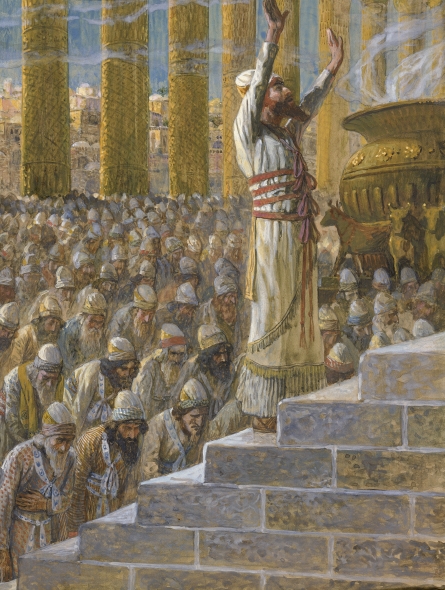
After Solomon became king and the LORD gave him rest from all his enemies, he built the Temple of the LORD as God had directed David, “your son will build the temple.” (1 Kings 5:5) It took seven years from the time that the Temple foundation was laid until it was completed. Along with the temple itself, many other things were built for the temple.
“the two pillars;
the two bowl-shaped capitals on top of the pillars;
the two sets of network decorating the two bowl-shaped capitals on top of the pillars;
the four hundred pomegranates for the two sets of network (two rows of pomegranates for each network decorating the bowl-shaped capitals on top of the pillars);
the ten stands with their ten basins;
the Sea and the twelve bulls under it;
the pots, shovels and sprinkling bowls.” (1 Kings 7:41 – 45)
Also, “the golden altar;
the golden table on which was the bread of the Presence;
the lampstands of pure gold (five on the right and five on the left, in front of the inner sanctuary);
the gold floral work and lamps and tongs;
the pure gold basins, wick trimmers, sprinkling bowls, dishes and censers;
and the gold sockets for the doors of the innermost room, the Most Holy Place, and also for the doors of the main hall of the temple.” (1 Kings 7:48 – 50)
Within the inner sanctuary or the “most holy place, two large statues of cherubim were placed of olivewood. All of the surfaces within the inner sanctuary including the statues were covered in gold. “The wing of one cherub touched one wall, while the wing of the other touched the other wall, and their wings touched each other in the middle of the room.” (1 Kings 6:27)
After the temple was completed, the Tabernacle furnishings including the Ark of the Covenant was brought to it. “ The priests then brought the ark of the Lord’s covenant to its place in the inner sanctuary of the temple, the Most Holy Place, and put it beneath the wings of the cherubim. The cherubim spread their wings over the place of the ark and overshadowed the ark and its carrying poles. These poles were so long that their ends could be seen from the Holy Place in front of the inner sanctuary, but not from outside the Holy Place; and they are still there today. There was nothing in the ark except the two stone tablets that Moses had placed in it at Horeb, where the Lord made a covenant with the Israelites after they came out of Egypt. and placed under the wings of the cherubim statues.” (1 Kings 8:6 – 9)
Then the glory of the LORD filled the Temple. “When the priests withdrew from the Holy Place, the cloud filled the temple of the Lord. And the priests could not perform their service because of the cloud, for the glory of the Lord filled his temple.” (1 Kings 8:10 – 11)
Solomon spoke to the people and honored God for fulfilling His promises.
Solomon prayed to the LORD. The following is part of that prayer. “Now Lord, the God of Israel, keep for your servant David my father the promises you made to him when you said, ‘You shall never fail to have a successor to sit before me on the throne of Israel, if only your descendants are careful in all they do to walk before me faithfully as you have done.’ And now, God of Israel, let your word that you promised your servant David my father come true.” (1 Kings 8:25 – 26)
Afterward, the LORD spoke to Solomon a second time. (The first time was when God approached Solomon to ask for anything and Solomon asked for wisdom to rule the people.)
Solomon was arguably the greatest and wisest king that ever lived. The problem is that Solomon did not finish well. The writer of Ecclesiastes, the Song of Solomon, and many Proverbs eventually turned to worship false idols. He had married many women (700!) from the peoples that God had commanded the Israelites do not marry because “they will surely turn your hearts after their gods.” (1 Kings 11:2)
True enough, he built altars to other gods for his wives to worship, including the detestable Chemosh of the Moabites and Molech of the Ammonites. He offended God who pronounced a judgement on Solomon – the kingdom would be ripped from Solomon’s line. Jeroboam, an enemy, would eventually become the King of Israel and Rehoboam, Solomon’s son, would be the King of Judah only.
Because of Israel’s actions, God would enact the curses of Deuteronomy 28 and Leviticus 26. Eventually, the Kings and the people of Israel and Judah (with a few exceptions) would be so bad that the ten tribes of the Kingdom of Israel would be lost, and the Jews would be exiled. The Temple of Solomon would be destroyed, and the Ark would be lost to this day.
In some respects, we are now living in a time when we have turned away from God. The Barna group published an article in 2020 that stated, “Currently, just one in four Americans is a practicing Christian.” (https://www.barna.com/research/changing-state-of-the-church/) According to the article, “Practicing Christians identify as Christian, agree strongly that faith is very important in their lives and have attended church within the past month.” Other parts of the world seem to be increasing in Christian belief, but the American experience is showing a decline.
However, I have hope in God. In a real way, every generation of Christian believers are always “first generation” meaning that I can’t decide for anyone other than myself what I choose to believe, and no one can else can decide that for me either. Somehow, amid great adversity, God somehow maintains a “remnant” that are His people.
All we can do as Christians is to trust in God and obey Him. That is a life-long commitment which must be renewed daily. Otherwise, the witness we have of God is diminished like Solomon’s witness was later in his life. Solomon, wise king, builder of the first Temple of God, and author of Wisdom literature forsook his witness for God when he followed his wives and concubines to worship false gods.
So, do you believe in God and the saving power of Jesus Christ? My hope is that you do. As Paul said, “I have fought the good fight, I have finished the race, and I have kept the faith.” (2 Timothy 4:7)
May God bless you.
Lesson 30: Can One Lose Salvation?

I recently heard someone express an opinion that salvation could be “given up” based on a passage from Romans 11:20-22. His thinking is based on the idea that although John 10:28 says, “No one can snatch them from my hand” that it doesn’t presuppose that one could walk out of God’s hand on their own.
If you have read the story of my testimony on this site, you know that I walked away from God for about ten years because I was angry that God had allowed my father to die at a young age. I ended that testimony with “even I could not snatch myself out of the hand of God.”
However, if I had chosen not to “return to God,” could I have “given up my salvation?” The person who believes that it is possible recounted how a door can be locked such that no one could get in and attack you (snatch you) but that does not presuppose that you could unlock the door and just walk out.
It is an interesting thought and one that deserves attention. Now, as a practicing Christian and a believer in God and Jesus Christ, I believe that if someone believes unlike me that salvation can be given up it doesn’t make one less of a Christian (just mistaken). Many things in the Roman Catholic church I absolutely do not agree with, but where we believe alike about Jesus Christ is where we are fellow Christian brothers and sisters. This idea of salvation, is not a “core belief” that determines if one is Christian or not – but it’s important enough that it should be addressed.
Let’s examine this idea of “giving up salvation” in detail. As a Baptist, part of the theology that I ascribe to is “Perseverance of the Saints” or in another way, “Once saved, always saved.” I once heard an evangelist preach a sermon and part of that sermon was “If your adult child comes to you and says, ‘Momma, I’m an atheist now. I don’t believe in Jesus anymore.’ Then you don’t have to worry. The child of yours who truly believed in Jesus is going to heaven when he dies.”
In contrast, the reason that some people believed the opinion that salvation could be lost had to do with their personal experience with family members who grew up believing in Jesus and then totally and completely walked away from God. People who believe as I do that salvation is fixed regardless of what happens later usually say, “Well, then, they never believed in Jesus in the first place.”
The people who believe that salvation can be lost get angry at this dismissive comment: “it’s a copout, it’s a rote response” that makes them angry because of their personal experience with family members who genuinely have walked away from God.
Also, let’s look a little more closely at the Bible where Paul is speaking in Romans that was referenced. Here Paul is talking to Gentile believers about Israel (who are typified as part of the cultivated olive branches) and Gentile believers (who are typified as wild olive branches that have been grafted into the root of the cultivated olive tree).
“If some of the branches have been broken off, and you, though a wild olive shoot, have been grafted in among the others and now share in the nourishing sap from the olive root, do not consider yourself to be superior to those other branches. If you do, consider this: You do not support the root, but the root supports you. You will say then, “Branches were broken off so that I could be grafted in.” Granted. But they were broken off because of unbelief, and you stand by faith. Do not be arrogant, but tremble. For if God did not spare the natural branches, he will not spare you either.
Consider therefore the kindness and sternness of God: sternness to those who fell, but kindness to you, provided that you continue in his kindness. Otherwise, you also will be cut off. And if they do not persist in unbelief, they will be grafted in, for God is able to graft them in again. After all, if you were cut out of an olive tree that is wild by nature, and contrary to nature were grafted into a cultivated olive tree, how much more readily will these, the natural branches, be grafted into their own olive tree!” (Romans 11:17 – 24)
Israel, when they rejected Jesus, were cutoff because of unbelief. The supposition here is that if a Gentile believer does not “continue in his kindness” they will be “cut off” because of their unbelief. But, if the “cut off branches” or Israel were to “believe” then they would be “grafted into their own olive tree.”
Remember that Paul was a Jew and a trained Pharisee. He was one who had persecuted the Christians prior to his conversion on the road to Damascus. He thought he was fulfilling the will of God by trying to stamp out Christian belief and believers. After becoming a believer himself, Paul now yearned for all Israel to know the crucified and resurrected Christ. He also doesn’t want the Gentiles to think they are superior to the non-believing Jews.
Also, he’s not writing here about individual salvation. He’s not talking about individuals at all. He’s talking about people groups; the Jews and the Gentiles. When Israel (or the Jews) rejected Jesus they were “cut off” from further participation in the redemptive plan of God because of their unbelief. Instead, the Gentile people group who by faith believed in God were given responsibility in participating in God’s plan for history. Else, how could Israel who was “cut off for unbelief” be grafted in again? It all has to do with future participation in God’s story. As Revelation specifically states, Israel (as a people) will have an important role in the End Time.
Consider the United States of America; I would argue that its founding was based on the religious principles of Christianity. As I recorded in the last lesson, the Barna group wrote an article that “only one in four Americans is a practicing Christian.” Future decline in this category may find that America as a people group will be “cut off” from participating in God’s further redemptive plans and will be replaced by others (Chinese Christians or African Christians?).
It’s telling to me when I’ve heard in this century that Chinese Christians pray for persecution of the American church to strengthen our church or that a Spiritual Awakening as evidenced by what happened in Asbury, Kentucky point to the fact that we need one!
I think that an individual choosing to give up salvation after fully and completely committing themselves to Jesus is a completely erroneous idea. As I stated in my testimony on this site, “I could not snatch myself from the hand of God.” The strongest reason why is that I am not God, I am merely one of His creations. As such, when John writes, “My Father, who has given them to me, is greater than all; no one can snatch them out of my Father’s hand.” (John 10:29) The term “no one” also includes me trying to snatch myself out of the Father’s hand.
Second, once I belong to God, I don’t think the God of Love is just going to let me walk away from him completely because He loves me that much. One of the people I talked to said, “I don’t think God is going to take to heaven someone who is kicking and screaming not to go.” And I countered, “But God knows a lot more about the heart of that person than you or I; and, He is the God of all time, not just at the end of someone’s life.” As it is, John also recorded Jesus words in John 6:65, “He went on to say, ‘This is why I told you that no one can come to me unless the Father has enabled them.’” The One who enabled me to come to Jesus (as I couldn’t do it on my own) is not going to enable me to walk away from Him completely.
R.C. Sproul wrote an article (https://www.ligonier.org/learn/articles/tulip-and-reformed-theology-perseverance-saints) where he points out that Paul also wrote to the Phillipians, “He who has begun a good work in you will perfect it to the end.” (Phil. 1:6)
In the gospel of John, many who had walked with Jesus turned away from him as recorded in John 6:60 – 66 after he had expressed that he was the “Bread of Life.” In the same article, Sproul quotes John, “The Apostle John notes that there were those who left the company of the disciples, and he says of them, ‘Those who went out from us were never really with us.’ (1 John 2:19)” However, the full text of that scripture says, “They went out from us, but they did not really belong to us. For if they had belonged to us, they would have remained with us; but their going showed that none of them belonged to us.” (1 John 2:19)
Third, there are people who are saved that will get in by the “escaping as through the flames” (1 Corinthians 3:15) because their witness after salvation will be poor indeed. But that is the key, the reason we need to obey Jesus is not because disobedience imperils our salvation but because disobedience imperils our witness of Jesus Christ, crucified and resurrected, Savior of mankind.
Fourth, only God knows the heart of one who professed faith in Jesus and we can never know as well as God does. We should be circumspect to make judgments about people we cannot know as well as God when it comes to their salvation.
Finally, salvation is truly a gift of grace from God that we can either accept or reject. The last reason that I believe in the dictum of “Once saved, always saved” is best summed up of one last Bible passage and the words of R. C. Sproul from the article mentioned above:
“Jesus even warns at the end of the Sermon on the Mount that at the last day, many will come to Him, saying: ‘Lord, Lord, didn’t we do this in your name? Didn’t we do that in your name?’ He will send them away, saying: ‘Depart from Me, you workers of iniquity. I never knew you’ (Matthew 7:23). He will not say: ‘I knew you for a season and then you went sour and betrayed Me. No, you never were part of My invisible church.’ The whole purpose of God’s election is to bring His people safely to heaven; therefore, what He starts He promises to finish. He not only initiates the Christian life, but the Holy Spirit is with us as the sanctifier, the convictor (sic), and the helper to ensure our preservation.”
So then, what about that person who walked away from God? Well, that was me. But God refused to let go of me. He lovingly brought me back to Him because I belonged to Him since I was a child. He was true to his word. As Sproul says in his article, “My confidence in my preservation is not in my ability to persevere. My confidence rests in the power of Christ to sustain me with His grace and by the power of His intercession. He is going to bring us safely home.”
Gloria in Excelsis Deo
What is this site?
I created this site to discuss end time prophecy. Out of all the prophecies in the Bible, the end time prophecies are the ones that have yet to happen. Most of these were recorded in the book of Revelation; however, several other books in both the Old and New Testament speak about the end times.…
The Context of the Study
“Behold I stand at the door and knock. . . (Rev. 3:20) ” The Context or My Testimony When I was a boy of seven years, I went to my Mother and my Father and stated with certainty, “I want to be a Christian.” I had grown up in the church for as long as…
My Testimony
When I was seven, I became a Christian. The following Sunday, I was baptized. Life was perfect ever since. Wouldn’t that be nice? Of course, you know that life is not perfect and it hasn’t been for me either. I won’t bore you with everything that happened. I grew up in the church. I went…
Get new content delivered directly to your inbox.
 End Time Prophecy Study