Lesson 40: Olivet Discourse (Prelude) – Widow’s Mite
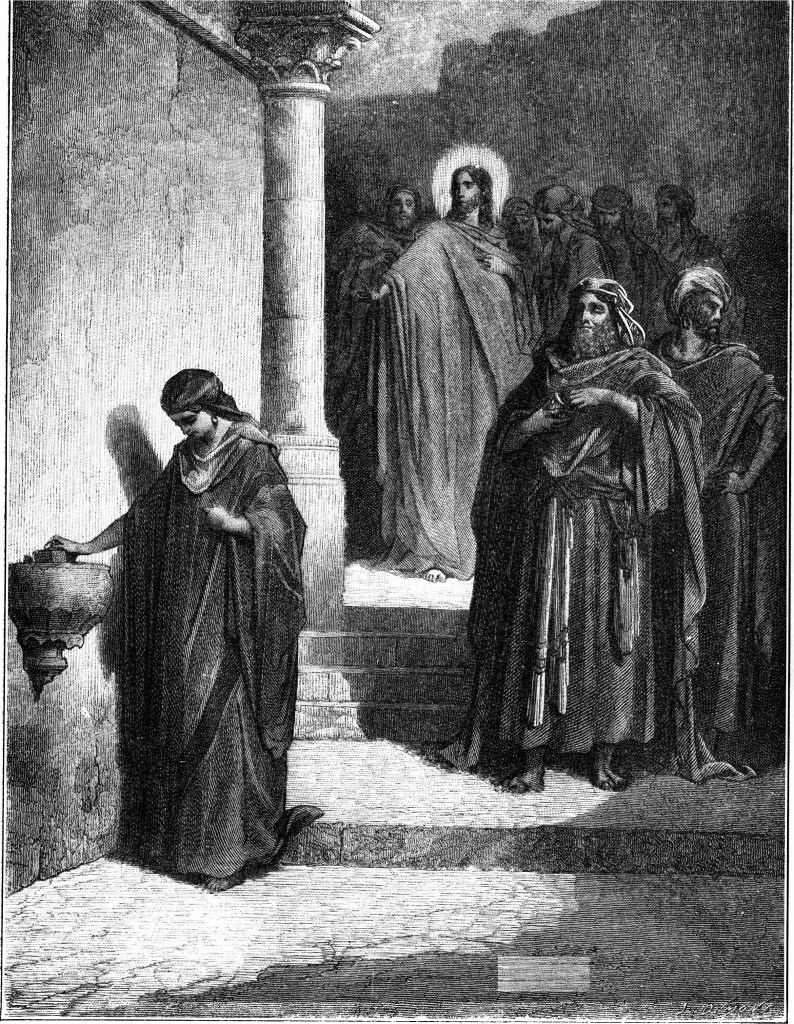
“As Jesus looked up, he saw the rich putting their gifts into the temple treasury. He also saw a poor widow put in two very small copper coins. ‘Truly I tell you,’ he said, ‘this poor widow has put in more than all the others. All these people gave their gifts out of their wealth; but she out of her poverty put in all she had to live on.’” (Luke 21:1 – 4 NIV)
Both Luke and Mark (ch. 12:41 – 44) record this event before Jesus begins the Olivet Discourse which discusses many weighty things related to his prophecy of the end times. It is appropriate to begin approaching His pronouncement by discerning the lessons we can glean from this event of the offering by the widow.
What observations can we glean from this passage in Luke?
- Jesus noticed the rich putting their gifts into the temple treasury.
- Jesus also noticed a woman put a gift into the temple treasury.
- In the narration of the event, the woman is identified as a “poor widow.”
- Jesus saw the “poor widow” put in two copper coins.
- The two copper coins were called “very small.”
- Jesus spoke to his disciples.
- The subject of Jesus speaking was the “poor widow.”
- Jesus called the woman a “poor widow.”
- Jesus characterized the woman as “poor” when he identifies her.
- Jesus also characterized the woman as a “widow” when he identifies her.
- “Poor” was an indication of her wealth.
- “Widow” was an indication of her current status (her husband had died).
- Jesus said that the “poor widow” gave more than “all the others.”
- Again, the others Jesus had noticed were the rich who also gave gifts.
- Jesus says the “rich gave out of their wealth.”
- Jesus says the “poor widow” gave out of her “poverty.”
- Jesus says that the “poor widow” gave “all she had to live on.”
- Jesus is not saying that the rich gave more money although they apparently had because all the “poor widow” had given was two “very small copper coins” which was probably the least amount of money he had seen given at this time.
- The reason the “rich” gave less according to Jesus is apparently because she gave “everything she had to live on” and the “rich” had not given “everything they had to live on.”
- No one was apparently accompanying the “poor widow” when she gave “all she had to live on” as no one else is mentioned by Jesus or in the narration.
What lessons can we glean from this event?
Jesus notices people. I think Dore’ got this right when he shows the rich with their heads held high and not alone and the widow with head bowed down and alone. I like that Jesus is in the background of this artistic representation with the disciples milling around him as he explains what is happening.
Jesus knows peoples’ situation. We cannot discern from Dore’s artwork that the woman is a widow. Frankly, Luke’s and Mark’s passage remarking this event is most likely informed by Jesus supernatural knowledge of the woman’s financial situation (poverty) and family situation (widowed).
Jesus knows peoples’ actions and the heart behind the actions. It is most likely that the poor widow was trying to surreptitiously drop the small coins into the treasury without being noticed. After all, who wants to be ridiculed for giving such a small amount to the temple in comparison to the more massive amounts given by the wealthy. In one respect, she could have chosen not to approach the temple treasury to give anything since those two coins were all she had to live on.
The poor widow gave anyway because she regarded the giving of all her “wealth” as the right thing to do. And because Jesus knows everything about this situation, he commends her to his disciples because he knows her heart.
We have no idea what happens after this event to the woman. This is something I would like to know. Did she go back to her domicile and find a bag of coins on her table? Did she go home and find a crust of bread to eat? Did her situation of poverty or her familial/social situation change? Was she peaceful in heart after she gave her all? Was she worried? We don’t know anything more about her.
We do know what happens to Jesus after this event. I’m not talking about the Olivet Discourse which we will begin in the next lesson. I’m talking about the Passion of the Christ who will die on the cross for the sins of all which will directly impact the poor widow, the rich, the disciples and everyone else in the entire world. “For the Son of Man came to seek and to save the lost.” (Luke 19:10 NIV)
Lesson 41: Olivet Discourse – Statement and Response

In three gospels, Jesus delivers the Olivet Discourse: Mark 13, Matthew 24-25, and Luke 21. All of these records start with a statement by the disciples and a response from Jesus that leads to an important question.
From Mark 13:1-2: “As Jesus was leaving the temple, one of his disciples said to him, ‘Look, Teacher! What massive stones! What magnificent buildings!’
‘Do you see all these great buildings?’ replied Jesus. ‘Not one stone here will be left on another; every one will be thrown down.’” (NIV)
From Matthew 24:1-2: “Jesus left the temple and was walking away when his disciples came up to him to call his attention to its buildings. ‘Do you see all these things?’ he asked. ‘Truly I tell you, not one stone here will be left on another; every one will be thrown down.'” (NIV)
From Luke 21:5-6: “Some of his disciples were remarking about how the temple was adorned with beautiful stones and with gifts dedicated to God. But Jesus said, ‘As for what you see here, the time will come when not one stone will be left on another; every one of them will be thrown down.’” (NIV)
When I was younger, I had an opportunity to visit Italy. One of my favorite memories was entering the Basilica of Saint Peter. As the door opened and I walked in, my first thought was “Wow! This place is HUGE!” The Basilica of Saint Peter is the largest church building in the world. Immediately to the right was the Pieta of Michelangelo behind bullet proof glass. The church is a Roman-Catholic design in the form of the cross. I was even able to go into the crypt where the Popes were entombed.
As impressive as it is, one thing I know about Saint Peter’s is that eventually the church building may cease to exist. How do I know that? Because, there will be a “New Heaven and a New Earth” as reported in Revelation. Whether that means that the old world will be destroyed and a new one created or that “all will be made new,” I do not know. But the possibility exists.
To the Jews of Jesus’ day, the Temple was the center of the worship of God. These disciples knew their history – how God had provided the plan of the Tabernacle in the wilderness which was built by the Israelites under the direction of Moses; how Solomon had built the temple and Nebuchadnezzar had destroyed it because of the idolatry of the Jews; how Zerubabbel and Joshua (the High Priest) had rebuilt the temple (and Herod had expanded it).
To hear that the Temple was to be destroyed again would have been troubling to the disciples. But Jesus had prophesied the destruction of the Temple which led them to later ask a question of Jesus.
It would be easy to concentrate on what happens to the Temple and the prophecy of its coming destruction based on the response of Jesus to the disciples.
However, more important than the Temple and what happens to it is the person who speaks about it: Jesus. Don’t get me wrong, the prophecy that Jesus gives in the Olivet Discourse is extremely important; but, we must not lose sight that the speaker of that prophecy, Jesus as the Son of God and the destruction of His Temple (“Destroy this temple, and I will raise it again in three days.” John 2:19 NIV) is far more important in this context.
When we consider the current chaotic times that exist in the world right now, we must not get mired in our fears of the future. Instead we should remember the “Author of life” (Acts 3:15) and the fact that He is in control.
Jesus speaks about coming trouble to his disciples. But He also speaks about how they (and we) will endure the difficult times because of God’s steadfastness, love, and certainty.
Lesson 42: A Digression: The people in Hell

You and I are going to know people in Hell after the consummation of the Return of Christ, the judgment at the White Throne of Judgment and punishment of the damned into the lake of fire where Satan and the Antichrist have been cast.
I don’t mean people like Hitler or Stalin or name your particular despot. I mean people that we love in this life. I mean our father or mother, our wife or husband. I mean our children, or our grandchildren, our brother, our sister, or our cousin – people that we love that we have high hopes for that will come to be redeemed to God through the saving work of Jesus Christ who refuse to trust in his salvation and do not acknowledge him as Lord.
I believe that we who will be redeemed to God at the coming of the Lord Jesus will know about these people. We will know that they are in torment forever while we have been saved to eternal habitation in the presence of God. We will have received our rewards, small or great, for the work we have done for God and Jesus and they will suffer their eternal punishment in hell forever for the sins that they have committed. I believe this because of the parable that Jesus told about Lazarus and the rich man.
Lazarus goes to paradise and stands with Abraham. The rich man is in the abode of the dead where he is suffering the beginning of his eternal punishment. Even though a great divide separates the characters in the parable, they are aware of what is happening in the “other place.” (Luke 16:19-31)
Once, I read the book of Revelation which talks about the lake of fire and the “second death.” I believed that souls thrown into the lake of fire would be annihilated – burned to a crisp to non-existence as if a live body had fallen into a volcano in our world which would extinguish life in this world so very quickly.
But that is not to be.
Instead, our loved ones who deny the salvation of Jesus Christ will be tormented in hell for all eternity. What will make it truly hell will be the absence of God, the Almighty Father, Jesus Christ the Son, and the Holy Spirit. Beyond the torments which are reserved as punishment for those lost souls, what will make it truly hell is the fact that they chose not to have God in their lives and God will perpetuate that choice through all of eternity.
That tears my soul to pieces. I remember the first time that I attended a concert for a famous singer in a basketball stadium and God struck me with the thought, “How many of these people in this arena are going to spend eternity with God? How many of these people in this arena are going to spend eternity without God in Hell?”
It’s a sobering thought. What’s worse is that there will be people that we care for in this life that will never know the comfort of God and will suffer forever in hell without that comfort. I remember once reading a biography of Dwight L. Moody who saw himself as a man in a lifeboat where the massive ship was sinking and his purpose was to get as many people in the lifeboat as possible before they all drowned.
That’s now how I see my entire purpose. You might die without knowing Jesus. What’s worse, is that people that I know personally – even ones in my own family may suffer that same destiny – and then suffer for all eternity without God in Hell.
God help me if I don’t do everything in my power, everything in my skill set, everything in the spiritual gifts that have been given me by God to try and bring as many people as possible into the lifeboat of God’s saving grace so that they can spend all of eternity redeemed to You.
Now is your chance. Do not refuse it. Believe in the Lord Jesus and be saved.
“But what does it say? “The word is near you; it is in your mouth and in your heart,” that is, the message concerning faith that we proclaim: If you declare with your mouth, “Jesus is Lord,” and believe in your heart that God raised him from the dead, you will be saved. For it is with your heart that you believe and are justified, and it is with your mouth that you profess your faith and are saved. As Scripture says, “Anyone who believes in him will never be put to shame.” (Romans 10:8-11 NIV)
Do it. Or else.
Get new content delivered directly to your inbox.
 End Time Prophecy Study