Lesson 7: Tower of Babel (Genesis 11:1 – 9)

“Now the whole world had one language and a common speech. As people moved eastward, they found a plain in Shinar and settled there.
They said to each other, ‘Come, let’s make bricks and bake them thoroughly.’ They used brick instead of stone, and tar for mortar. Then they said, ‘Come, let us build ourselves a city, with a tower that reaches to the heavens, so that we may make a name for ourselves; otherwise we will be scattered over the face of the whole earth.’
But the Lord came down to see the city and the tower the people were building. The Lord said, ‘If as one people speaking the same language they have begun to do this, then nothing they plan to do will be impossible for them. Come, let us go down and confuse their language so they will not understand each other.’
So the Lord scattered them from there over all the earth, and they stopped building the city. That is why it was called Babel[c]—because there the Lord confused the language of the whole world. From there the Lord scattered them over the face of the whole earth.” (Genesis 11:1 – 9 NIV from biblegateway.com)
According to the Bible mankind gathers in the plain of Shinar to build a city for themselves and erect a tower into the heavens. The purpose of that was to “make a name for themselves” in defiance of God. In essence, they were trying to make a memorial for themselves so that they could be remembered by mankind that were left behind after they died. They effectively turned their backs on God and His desire for relationship with them.
During Pentecost after Jesus ascension, many theologians see a redemption of this judgment when the Jews who have come from all over the known world to Jerusalem for this festival hear the gospel of Jesus in their own heart language (or their own local tongues).
But it’s good to remember the story of the tower of Babel considering end time prophecy. For example, mankind gathered in one place. This was in opposition to the commandment God had given to “go out throughout the whole world and fill it.”
Also, God saw that having only one language, sinful mankind had chosen not to be unified under God but to become unified only unto themselves. Mankind was able to do an amazing thing in building a city and constructing a tower (as if that was the way to heaven). God knew that their trying to “make a name for themselves” was not in the best interests of mankind.
Further, God gives mankind a second chance when his judgment confuses their language. God does not bring death to the people nor destruction to the city. Instead, His judgment helps to restore the people to fulfilling one of the original purposes for which God had created mankind, “to go out into all the world and fill it.” With the confusion of their language, the city and tower are abandoned.
Now, let’s look at how this applies to the end time. First, as the end time comes, mankind will be united once again against the purposes of God. We’ve seen all throughout history, rulers who come to power and lead people against God and His purposes. The final ruler at the end time will be the Anti-Christ. As we have already seen in the record of the tower of Babel, mankind has this sinful capacity to unify against God and to act against God’s purposes. A unity of mankind will follow the Anti-Christ against God’s purposes.
We also know that this ruler will have “authority over every “tribe, people, language, and nation.” (Revelation 13:7) This ruler will seem all powerful with the greatest of followings in history. The end time won’t be about a people with just one language, but every language on the entire planet.
What’s not recorded in the tower of Babel is if there were any dissidents who tried to point people back to the purposes of God before Gods judgment. However, during the end time, a brave minority will stand up and declare that the Anti-Christ and the people who follow him are not doing right by God. Their message will also proclaim the gospel of Jesus as the only path of redemption to God and that the unified majority should repent and accept Jesus as the ultimate authority instead of the Anti-Christ. The unity of the majority will act to quash this dissension by trying to win-over, persecute, and ultimately kill the minority.
But, just as in the story of the tower of Babel, God ALWAYS has the last word. And with that word will come judgment on the unredeemed. The other significant difference between the judgments on the plain of Shinar and the last judgment is that God gave a second chance to the people at the plain of Shinar. At the last judgment during the end time, there will be no more chances.
Lesson 8: Sodom and Gomorrah Destroyed (Genesis 19)
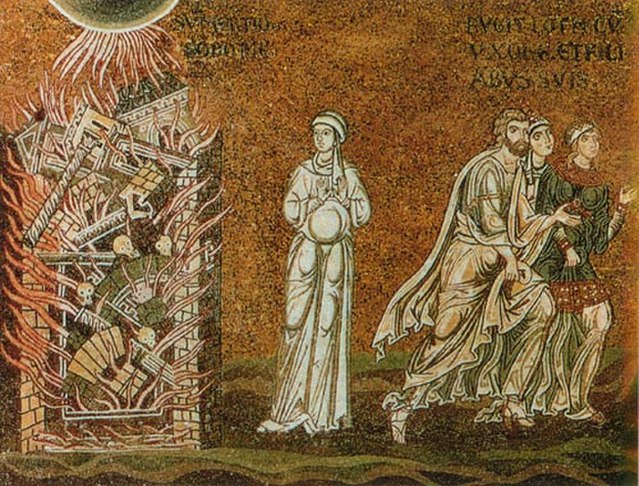
In Genesis 18, God reveals to Abraham that Sodom and Gomorrah (and other cities of the plain) are to be destroyed because of the evil the inhabitants are perpetrating. Abraham gains a promise from God (because of His mercy) that if even a minority of 10 good men existed that the cities would not be destroyed.
The angels arrive at Sodom and meet Lot who has been sitting at the gate. Notice that Lot is on the lookout for new people coming into the city because he knows the danger of that place. The angels intended to “sleep in the square” but Lot insisted they come to his house.
Because the inhabitants notice the new arrivals, they surround Lot’s house so that they can “have sex” with them. These inhabitants were so steeped in their sin that they needed something new to excite them. They even turn down Lot’s (shameful) offer to rape his daughters.
Judgment is passed and begins with the blinding of those who have surrounded Lot’s house. Lot has an opportunity to warn his sons-in-law who don’t believe the coming punishment. Lot escapes with his family. However, Lot’s wife disobeyed God (“Don’t look back!”) and either mourned the loss of life she had in Sodom or just failed to obey God and turns back to look (not just a furtive look but a long, considered one) and is “turned into a pillar of salt.”
Sodom, Gomorrah, and the other cities of the plain are destroyed. Lot and his daughters eventually end up in a cave where the daughters proceed to drug Lot with drink so that he can impregnate first the older and then the younger. (Probably wouldn’t have happened if Lot’s wife had obeyed God.)
And that’s the end of the story – except it really isn’t. The actions of this story become part of the very fabric of the history of Israel. The actions of Sodom, Gomorrah, and the other cities of the plain that were destroyed by God’s wrath are used as object lessons. (Don’t be like Sodom and Gomorrah or else!”) Sodom and Gomorrah become a byword for utter sinfulness and the wrath of God’s judgment on that sinfulness.
When Israel is about to take possession of the land of Canaan after the exodus from Egypt and 40 years in the wilderness, Moses gives his final speeches before he dies. At the end of the book of Deuteronomy, Moses warns the Israelites to follow the covenant made with God after the exodus from Egypt or suffer the consequences.
“The whole land will be a burning waste of salt and sulfur—nothing planted, nothing sprouting, no vegetation growing on it. It will be like the destruction of Sodom and Gomorrah, Admah and Zeboyim, which the Lord overthrew in fierce anger. All the nations will ask: ‘Why has the Lord done this to this land? Why this fierce, burning anger?’
And the answer will be: ‘It is because this people abandoned the covenant of the Lord, the God of their ancestors, the covenant he made with them when he brought them out of Egypt.’” (Deuteronomy 29:23 – 25)
Again, Moses warns the Israelites not to follow other gods. (Deuteronomy 32:17) Because when they did, “Their vines comes from the vine of Sodom and the fields of Gomorrah.” (Deuteronomy 32:32)
Eventually, Israel and Jerusalem get compared to Sodom and Gomorrah because of their sinfulness, their turning away from the covenant of God to worship other gods (Isaiah 1:9 – 10; Isaiah 3:8 – 10, and Jeremiah 23:14). Like Sodom and Gomorrah, Jerusalem suffer the wrath of God (Lamentations 4:6). (See also the comparison in Ezekiel 16:44 – 63)
Other nations are also prophesied to suffer the overthrow of their nations like Sodom and Gomorrah – Babylon (Isaiah 13:19 and Jeremiah 50:40), and Edom (Jeremiah 49:18).
Even in the New Testament, Sodom and Gomorrah are used as object lessons to do right and avoid the wrath of God. In essence, the sin of spurning Jesus is in many ways worse than the sin of Sodom and Gomorrah. (“If anyone will not welcome you or listen to your words, leave that home or town and shake the dust off your feet. Truly I tell you, it will be more bearable for Sodom and Gomorrah on the day of judgment than for that town.” Matthew 10:14 – 15) (See also Matthew 11:23 – 24 and Luke 10:12; 17:29)
Finally, see this from Revelation about Jerusalem at the end time. In the discussion regading the Two Witnesses sent by God to Jerusalem who preach for three and a half years, they are eventually killed. “Their bodies will lie in the public square of the great city—which is figuratively called Sodom and Egypt—where also their Lord was crucified.” (Revelation 11:8)
What lessons can we learn from the story of Sodom and Gomorrah?
First, God (eventually) punishes sin.
Second, sometimes God uses that punishment to save his people. Lot would have been treated VERY badly by the evil men of Sodom when he refused them. (“We’ll treat you worse than them!”) Remember that the exiled Jews were allowed to return to Jerusalem by the Persian king (after Persia overthrew Babylon).
Third, God’s miraculous judgment does not always lead people to repentance or following God’s will. Both of Lot’s daughters initiated incestuous liaisons with their father AFTER Sodom and Gomorrah was destroyed by God. People experiencing the wrath of God in Revelation will also refuse to repent. “The rest of mankind who were not killed by these plagues still did not repent of the work of their hands; they did not stop worshiping demons, and idols of gold, silver, bronze, stone and wood—idols that cannot see or hear or walk.” (Revelation 9:20)
Finally, our duty is to spread the gospel of Jesus Christ. A time is coming when judgment will be final because the people judged will not EVER repent and follow God. Until that time, “The Lord is not slow in keeping his promise, as some understand slowness. Instead, he is patient with you, not wanting anyone to perish, but everyone to come to repentance.” (2 Peter 3:9)
If you haven’t yet repented of your sin, believed in Jesus and made Him Lord of your life, you may not have another chance. Do it today.
Lesson 9: The Plagues of Egypt

The Israelites were slaves in Egypt. They didn’t start out that way. They started out as guests of a favored Israelite, Joseph, who (by God’s grace) interpreted the dreams of Pharaoh. God had revealed to Joseph that Pharaoh’s dreams meant that seven great years of harvest would be followed by seven years of terrible famine. As such, Joseph was put in charge of all Egypt and kept the nation from starving.
The famine was so bad that eventually, the Egyptians sold off their properties, their livestock and finally themselves so that they would not starve. You might think that Joseph (and God!) would be remembered by the Egyptians for preventing the destruction of Egypt by famine. You would be wrong.
“Then a new king, to whom Joseph meant nothing, came to power in Egypt.” (Exodus 1:8 NIV) The lesson here is to remember your history, it will save you grief in the long run. The new Pharaoh didn’t learned that lesson.
So, the slaves in Egypt cry out to God. And God sends them Moses. The conversation at the burning bush is instructive. I’m especially struck when Moses says at the end of it, “Please, God, send someone else.” And God’s anger “burned against Moses.” But of course, God forgives him and says, “How about we send your brother Aaron with you?” And of course, Moses obeys.
So Moses and Aaron present themselves as God’s representatives before Pharaoh where we see the drama unfold. If you forgot what the ten plagues are (when Pharaoh refuses to let the children of Israel leave Egypt) they are as follows: Nile turned to blood; Egypt filled with frogs; Egypt filled with gnats (or lice); Egypt filled with flies; death of livestock; boils on Egyptians; plague of hail (first human deaths); locusts destroy crops; darkness covers Egypt; and finally death of the firstborn.
There’s also a familiar pattern that develops in each of the exchanges before a plague begins:
- Pharaoh refuses to obey God by letting the Israelites go
- Moses gives pronouncement of God’s judgment and coming plague
- God causes the plague to happen
- Magicians provide a poor copy (until the gnats which they can’t copy and proclaim “this is the finger of God.”) Magicians can’t even stand in Pharaoh’s presence during the boils plague because of the pain they were suffering. (We don’t hear from them in the later plagues.)
- Pharoah “negotiates” with Moses
- Moses prays for the plague to end
At the ninth plague, Pharaoh tells Moses “don’t come into my presence again for if you do you will die.” (Pretty nervy when Egyptians couldn’t see because of the plague of darkness.) Moses agrees until God sends him back into Pharaoh’s presence to proclaim God’s judgment of the death of the firstborn (the final plague).
From a Christian perspective, the Passover is very symbolic of what Christ did for us. As the Israelites obeyed God by sacrificing a lamb to put blood on their side and upper doorposts so that the angel of death would “passover” their house and move on, so Christ did for us when He died on the cross for our sins and paid the penalty so that the angel of death will “Passover” us as we move on to eternal life with God.
Lest we forget, the Egyptians drove the Israelites out of Egypt – they had had enough of God’s judgment! But of course, Pharaoh and his officials lament letting their slaves go and the army chases after the Israelites. God delivered ten plagues to release Israel from Egypt, but he had one more miracle which impacted Israel and Egypt in the desert.
God parted the Red Sea and the Israelites crossed over to the other side. When the Egyptians tried to follow with their army and chariots, God stopped parting the Red Sea and all the Egyptians drowned.
What can we learn from this from an End Time Prophecy perspective?
First, the plagues of Egypt happened because Pharaoh was disobedient to God. The Revelation seals, bowls, and trumpet judgments of God will bring disaster on the earth (poisoned water, insects, locusts, destruction from the skies, diseases, and death) because of man’s disobedience to God.
Second, the purposes of such plagues (or judgments) are twofold – one is to show that God is sovereign. He far outstrips any other god people would worship (including the false gods of the Beast or of material items). The other is to finally bring His people into His presence. In the desert, the people are brought to the mountain of God and obtain the law. At the End Time, God will bring His people to the marriage supper of the lamb in Heaven.
Third, as judgments of God occur, God’s enemies will try to continue to deceive people. The magicians tried this in Pharaoh’s presence until they were proven to be no match for God. Satan will try this in the end by blaming the “Christians” for being the real “problem.”
Fourth, judgments will get worse as disobedience continues. The plagues of blood, frogs, gnats, and flies were irritants. The livestock plague brought death (to animals). The boils brought disease (to humans). Hail brought death to humans, livestock, and crops. Finally, the death of the firstborn brought death to every household. So also, the end time judgments will get worse as mankind continues to disobey and rebel against God.
Fifth, a final “hardening of the heart” will bring about a final judgment (and destruction).
But also remember this – although the Israelites didn’t suffer many of the plagues directly, they still suffered at the hands of the Egyptians. Remember, Pharaoh punished the Israelites by decreeing that they had to make bricks without Egyptian provided straw when Moses first told Pharaoh, “God says, ‘Let my people go!'” Also, Egyptian livestock all died during the plague on the livestock. Where do you think the Egyptians got new livestock from which died in the plague of hail?
At the end time, Christians will also suffer at the hands of the disobedient of God – but, those who persist in the Lord will be redeemed to stand before the throne of God clothed in the righteousness of Jesus.
What is this site?
I created this site to discuss end time prophecy. Out of all the prophecies in the Bible, the end time prophecies are the ones that have yet to happen. Most of these were recorded in the book of Revelation; however, several other books in both the Old and New Testament speak about the end times.…
The Context of the Study
“Behold I stand at the door and knock. . . (Rev. 3:20) ” The Context or My Testimony When I was a boy of seven years, I went to my Mother and my Father and stated with certainty, “I want to be a Christian.” I had grown up in the church for as long as…
My Testimony
When I was seven, I became a Christian. The following Sunday, I was baptized. Life was perfect ever since. Wouldn’t that be nice? Of course, you know that life is not perfect and it hasn’t been for me either. I won’t bore you with everything that happened. I grew up in the church. I went…
Get new content delivered directly to your inbox.
 End Time Prophecy Study