Lesson 49: The Warning of False Messiahs
“‘At that time if anyone says to you, ‘Look, here is the Messiah!’ or, ‘There he is!’ do not believe it. For false messiahs and false prophets will appear and perform great signs and wonders to deceive, if possible, even the elect. See, I have told you ahead of time.
So if anyone tells you, ‘There he is, out in the wilderness,’ do not go out; or, ‘Here he is, in the inner rooms,’ do not believe it.” (Matthew 24:23-26 NIV)
This seems self-evident, doesn’t it? However, to make sure that it is crystal clear, we need to look at a Biblical event as if it were a parable of what Jesus is talking about. To do that, we need to examine the Old Testament account of Jeroboam I also known as “the son of Nebat.”
1 Kings 11 begins Jeroboam’s story. An Ephraimite (descended from Joseph’s son Ephraim), he was put in charge by Solomon of the labor force of Joseph’s two tribes (Ephraim and Manassah) who built terraces as part of the wall of Jerusalem that had been left as a gap in the time of David.
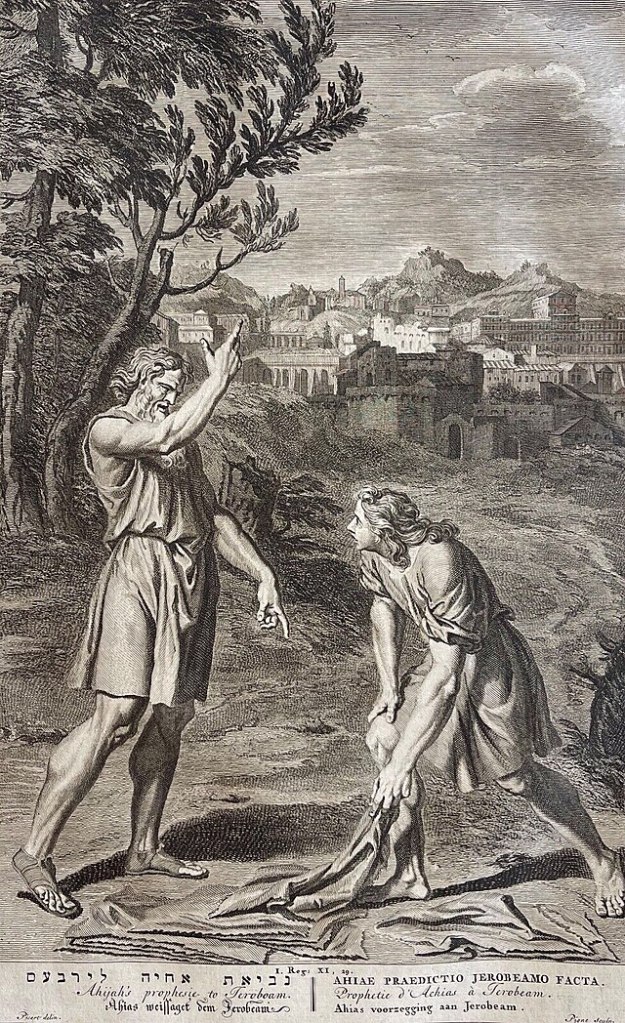
As Jeroboam leaves Jerusalem, a prophet from Shiloh named Ahijah wearing a new cloak meets Jeroboam. Ahijah tears the cloak into pieces and prophesies the intention of the LORD.
“Take ten pieces for yourself, for this is what the Lord, the God of Israel, says: ‘See, I am going to tear the kingdom out of Solomon’s hand and give you ten tribes. But for the sake of my servant David and the city of Jerusalem, which I have chosen out of all the tribes of Israel, he will have one tribe. I will do this because they have forsaken me and worshiped Ashtoreth the goddess of the Sidonians, Chemosh the god of the Moabites, and Molek the god of the Ammonites, and have not walked in obedience to me, nor done what is right in my eyes, nor kept my decrees and laws as David, Solomon’s father, did.” (1 Kings 11:31-33 NIV)
So God decided to raise up Jeroboam to be king over the 10 tribes of Israel because of Solomon’s apostasy following after the other gods of his wives from foreign lands. Ashtoreth was a Caananite false-god whose worship involved sexual immorality and cult prostitution. Chemosh worship involved human sacrifice as when the King of Moab sacrificed his son. Molek worship involved child sacrifice. (Remember that Ammon and Moab were sons of Lot by way of his daughters after the destruction of Sodom and Gomorrah.
Here’s a key piece we need to understand from the prophecy from the LORD through Ahijah. “However, as for you, I will take you, and you will rule over all that your heart desires; you will be king over Israel. 38 If you do whatever I command you and walk in obedience to me and do what is right in my eyes by obeying my decrees and commands, as David my servant did, I will be with you. I will build you a dynasty as enduring as the one I built for David and will give Israel to you.” (1 Kings 11:27-28 NIV)
Did you catch that? “If you do whatever I command you and walk in obedience to me. . . I will be with you. I will build you a dynasty as enduring as the one I built for David.” And what was David’s dynasty like? Despite Solomon’s apostasy, for the sake of David, God left a remnant of Israel (in the kingdom of Judah) the hands of Solomon’s progeny starting with Rehoboam. And who was David’s ultimate descendent – Jesus Christ.
But what did Jeroboam do? Well, he didn’t follow the LORD after he ascended the throne of Israel. We’ve seen that in an earlier lesson on this website. Because of his fear that the Israelites would turn back in allegiance to Rehoboam when they went to the temple to offer sacrifices to the LORD (as the Jerusalem temple was the only legitimate place to worship God in this way), Jeroboam setup false idols at Bethel and Dan for the Israelites to worship instead. In this way, Jeroboam was not the “messiah” he could have been for the kingdom of Israel – he ended up turning away from God and being a “false messiah.”
And what happened to Jeroboam’s dynasty? When his son, Abijah became sick, he sent his wife to Ahijah, now an old man, to find out what the LORD intended. Ahijah’s prophecy ensured that Abijah would die as soon as the wife returned home and that another would cut off every male of Jeroboam’s household. Jeroboam eventually died and Nadab, his son became king for two years until he was overthrown by Baasha of the tribe of Issachar who ended up fulfilling the words from the LORD through Ahijah. Here is part of that prophecy, “You have done more evil than all who lived before you. You have made for yourself other gods, idols made of metal; you have aroused my anger and turned your back on me.” (1 Kings 14:9 NIV)
So, watch out when someone suggests that the “Messiah has returned.” Even Jesus states that it will be evident to the whole world when He returns.
What is interesting to me is that I dreamt of the phrase “the son of Nebat” which led me to search for who that was which led me to Jeroboam. And why is this significant in relation to the passage in Matthew that we first looked at? “Nebat” in the Hebrew is derived from the Hebrew verb “nabat” meaning “to look or consider.” Blessings for those who follow the truth and not deception.
Lesson 50: The Return of Jesus Christ
When I was young, I had an enormous opportunity to take a high school trip to Italy. I’ve actually told you this story before – at the beginning of the first lesson.
Recently, I rewatched a movie called The Agony and the Ecstasy starring Charlton Heston as Michelangelo and Rex Harrison as Pope Julius II. The film is all about the painting of the Sistine Chapel ceiling and the relationship between the artist and the Pope. My favorite exchange which happens multiple times is Harrison as Pope asking Heston as artist, “When will you make an end?” and Heston as artist saying, “When I am finished.” A throwaway line at the end of the movie is the Pope talking to Michelangelo and saying, “You should really do something about that wall.”
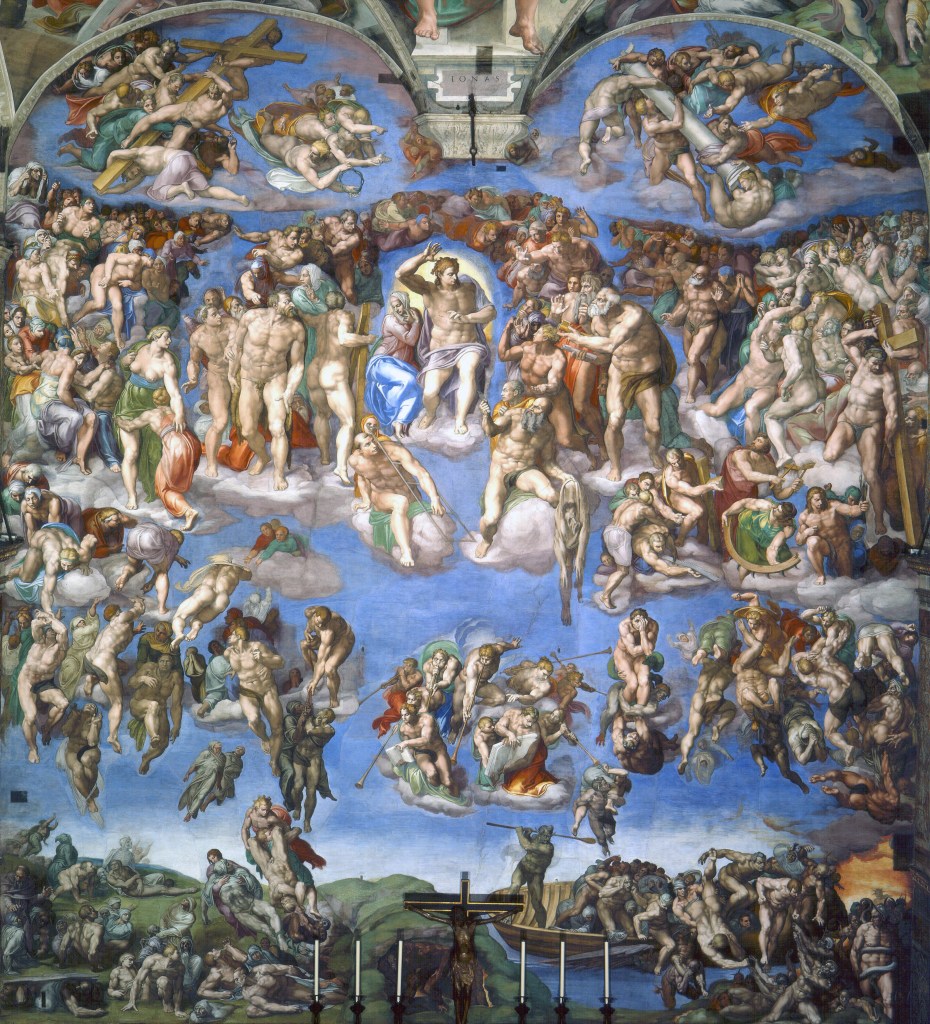
The fact is that Michelangelo painted “The Last Judgment” after painting the ceiling. My experience of seeing the ceiling was amazing as I marveled at the genius of the painting on the ceiling; however, my breath was taken away when I saw that last painting on the wall. For years, it was the desktop picture on my computer.
Frankly, the Last Judgment happens towards the end of the End Times. But, the glory of Jesus as he descends from the Heavens in that painting is very reminiscent of how he will return.
“For as lightning that comes from the east is visible even in the west, so will be the coming of the Son of Man.” (Matthew 24:27 NIV)
This is how it will happen when the Son of God returns: Jesus will come suddenly, immediately, and His return will instantly be known across the whole world and He will be recognized for who He is.
But His return is not unexpected. The next line in the gospel seems to be a proverb. “Wherever there is a carcass, there the vultures will gather.” (Matthew 24:28 NIV)
Preceding His return will be the Wrath of God poured out on humanity as a last ditch effort by God Himself to call those to repent and accept the great sacrifice of Jesus on the cross to be redeemed to God by following Jesus as Lord and Savior (see the Book of Revelation).
By the time Jesus returns, I believe that the opportunity for choosing will be done. Not so much because God has mandated the end of choosing repentance, but because everyone still living will have already made their choice – to believe in Jesus or to spurn His great gift.
“‘Immediately after the distress of those days “the sun will be darkened, and the moon will not give its light; the stars will fall from the sky, and the heavenly bodies will be shaken.” Then will appear the sign of the Son of Man in heaven. And then all the peoples of the earth will mourn when they see the Son of Man coming on the clouds of heaven, with power and great glory. And he will send his angels with a loud trumpet call, and they will gather his elect from the four winds, from one end of the heavens to the other.”
(Matthew 24:29-31 NIV)
Why should the people mourn? Because these are those for which the return of Jesus will not be for salvation but for judgment.
We shall all stand before the judgment seat of God. My hope for you all is that the return of Jesus Christ will be for you a great comfort as He returns in all his glory and not one of dread.
As Peter said, “The Lord is not slow in keeping his promise, as some understand slowness. Instead he is patient with you, not wanting anyone to perish, but everyone to come to repentance.” (2 Peter 3:9 NIV)
Get new content delivered directly to your inbox.

